
Centering Justice is a collaborative project engaging a diverse range of the nation’s top thinkers and doers in an ongoing, ideologically vibrant conversation about criminal justice policy. Two pillars anchor the initiative. One is an allegiance to data and evidence; the second is a commitment to viewing criminal justice challenges through shared principles that enable people of different perspectives to find common ground on measures that strengthen public safety, protect due process, and promote fairness.
Centering Justice is led by two CCJ staff members – Director of Strategic Partnerships Khalil A. Cumberbatch and Chief Policy Counsel Marc Levin. Through writings, interactive events, partnerships, and other means, the duo strives to bring light rather than heat to some of the most vexing issues of our time, from the evolving role of policing to sentencing, incarceration, and racial disparities.
Building Common Ground
Safety. Fairness. Dignity. Accountability. This set of four bipartisan principles for criminal justice policy, each with brief defining language, was signed in January 2025 by 14 national advocacy organizations that span the ideological spectrum, from the Conservative Political Action Conference and the American Legislative Exchange Council on the right to the American Civil Liberties Union and the Leadership Conference on Civil and Human Rights on the left.
CCJ was honored to facilitate the extensive discussions that produced this statement of shared values, in partnership with the School of Public and International Affairs at Princeton University and with the sponsorship of The Just Trust.
Our Work

Event Recording: Second Chances: Sustaining Progress
As part of Second Chance Month activities, the Council on Criminal Justice’s Centering Justice initiative and a panel of experts examined how second chance policies are working in practice, what drives success and failure, and what it will take to sustain progress over time.
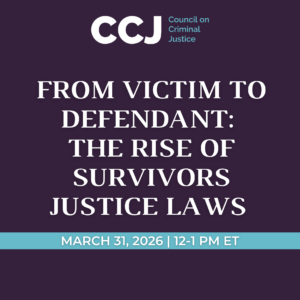
Event Recording: From Victim to Defendant: The Rise of Survivors Justice Laws
The Council on Criminal Justice and a panel of experts examined how survivors justice laws laws are being implemented, what challenges have emerged, and what policymakers and practitioners can learn from early experience across states.

Event Recording: More Guns, Less Murder?
The Council on Criminal Justice’s Centering Justice project hosted a conversation with leading experts about how gun policies, enforcement strategies, and market dynamics are shaping gun violence trends today—and the implications for policy and strategy.

Event Recording: The State of Criminal Justice Legislation in 2026
The CCJ Centering Justice project, the National Conference of State Legislatures, and the Future Caucus discussed the state legislative landscape for criminal justice in 2026 and prospects for policies that are based on solid evidence and can win bipartisan support.

Event Recording: The State of Crime and Justice: Year-End Insights
Leaders from the Council on Criminal Justice Centering Justice project and other experts discussed what the criminal justice field faced in 2025 and what we might expect in 2026.

Event Recording: Bail Reform at a Crossroads: Impacts on Public Safety and Justice
Leaders from the Council on Criminal Justice’s Centering Justice project hosted a vital discussion on the state of pretrial release policies in the United States and how to strike an appropriate balance between the twin goals of crime control and justice.
in the news

Can Trump Make America Less Retributive?

Ruby Ridge Reckoning Reveals Lessons for ICE

To Protect, Serve, and Identify

Make fraudsters fund services for crime victims

2026
- Can Trump Make America Less Retributive, CATO Institute
- Ruby Ridge Reckoning Reveals Lessons for ICE, RealClearPolitics
- To Protect, Serve, and Identify, Law & Liberty
- Make fraudsters fund services for crime victims, The Hill
- Criminalizing Officials’ Speech Erodes Trust in Justice System, Law360
2025
- How cutting the food safety net threatens the public safety net, The Hill
- Crime Victim Aid Should Not Be Tied to Immigration Status, Law360
- Clemency Shouldn’t Depend on Who You Know, but it Should Be Used More Often, Newsweek
- Protecting federal prisons from shutdown benefits all of us, Government Executive
- Pluralism requires supporting free speech, not criminalizing it, San Antonio Express-News
- The American Experiment Requires Robust Debate, Not Government Crackdowns, The Fulcrum
- Base bail decisions on risk, not riches, The Hill
- How Police De-Escalation Training Can Prevent Civil Unrest, The National Interest
- What We Should Be Doing for the Children of the Incarcerated, Governing
- A Stunning Verdict: A Shared Vision of Justice Unites Americans, The Fulcrum
- Post-Woke Criminal Justice Reform, Law & Liberty
- What Can Be Done to Make Prisons Better Workplaces, Governing
- Judicial Checks and Balances Are Essential to Justice, RealClear Politics
- Like Mahmoud Khalil or Not, Due Process is the American Way, The National Interest
- Polarizng Times Demand Bridging Divides: How Centering Justice Can Help Rebuild Trust, Convergence Corner
- 6 Criteria Can Help Assess Executive Branch Actions, Law360
- Second Chance Month Must Be a Gateway to Enduring Justice, Newsweek
- Banishing U.S. Citizens to El Salvador Puts American Values Last, Newsweek
- Common ground in Pa. on criminal justice, TribLIVE
- Deterring Dubious Prosecutions Could Avoid Pardon Issues, Law360
2023
- Trump’s Georgia Case Should Provide Impetus for Reining in Public Mugshots, Real Clear Policy
- Why We Need More College Graduates Behind the Badge, Governing
- America Doesn’t Need Public Mugshots of Donald Trump or Joe Blow, Washington Monthly
2022
- Why a strong, united America requires effective criminal justice policies, The Hill
- To Address the Corrections Staffing Crisis, Think Outside the Cell, Governing
- Guns: Yes, Virginia, There Really is a Middle Ground, The Crime Report
- Critical Race Query, Washington Monthly
About the Founders

Khalil A. Cumberbatch
Director, Engagement and Partnerships

Marc Levin
Chief Policy Counsel
About The Art
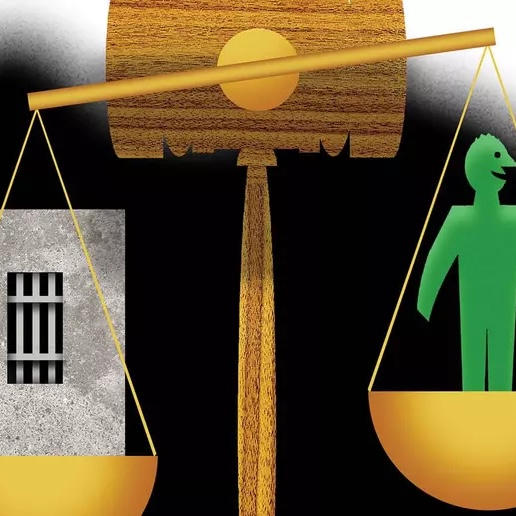
The banner design was created by an adult in custody designer in the Oregon Corrections Enterprises (OCE) Graphic Design program. The mission of OCE, in partnership with the Oregon Department of Corrections, is to promote public safety by providing adults in custody with work and training opportunities in a self-sustaining organization.