
Bipartisan cooperation on criminal justice policy has marked much of the past 20 years, but increasing political polarization and a COVID-era crime spike have severely strained collaborative efforts to cut crime and incarceration.
In fall 2024, leaders of more than a dozen leading national advocacy organizations across the ideological spectrum came together in search of uniting principles that can reignite partnerships. Convened by the Council on Criminal Justice and Princeton University’s School of Public and International Affairs, with support from The Just Trust, the groups crafted a shared vision that can guide bipartisan work into the future.
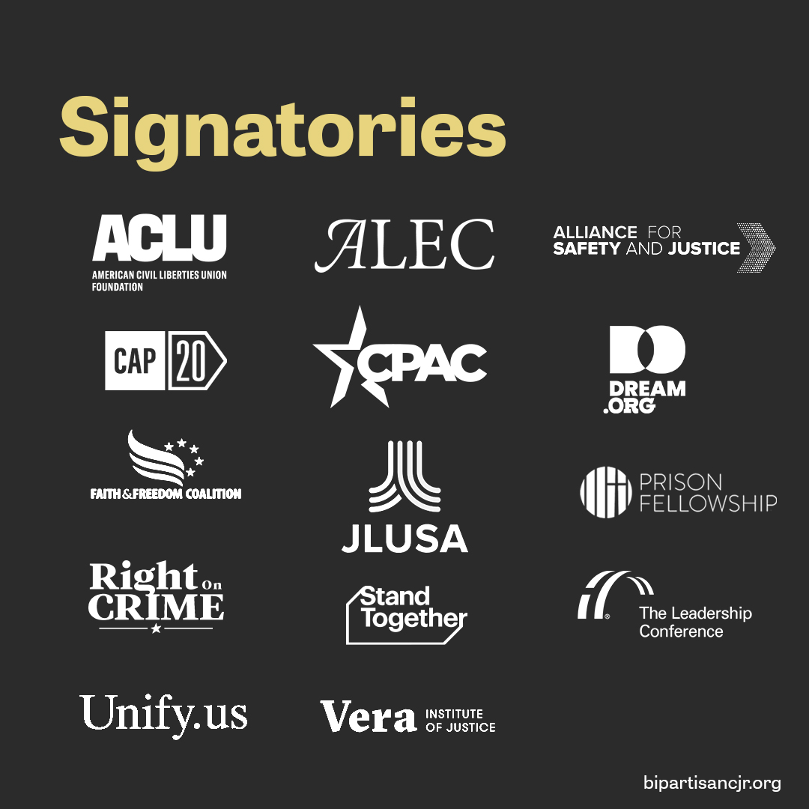
On June 3, 2025, the groups publicly launched the bipartisan principles at a virtual event hosted by CCJ. During the event, leaders who helped craft the principles explored the possibilities and power of bridging divides and finding common ground, including how they were able to overcome deep differences with the other organizations about many issues and how the principles can be used to shape policy at the state and federal levels.
According to these leaders and organizations, there are four principles that must shape the foundation of a justice system that is fair and effective, and that can foster national unity by earning the trust of all Americans:
- Safety: Everyone deserves to be safe. Lasting safety is created by using the best available evidence to prevent crime, enforcing laws in a manner that protects constitutional rights, helping crime survivors heal, providing second chances, and investing in the infrastructure and services that help people and communities thrive.
- Fairness: The justice system should uphold constitutional rights and liberties and apply the rule of law fairly and proportionally to all. Policies and practices should advance equal justice in the face of longstanding disparities along race, class, disability, and other lines, and actively work against any two-tiered system of justice.
- Dignity: Every person has inherent worth, value, and potential for change. All people should be treated with dignity and respect and afforded opportunities to contribute positively to their communities.
- Accountability: Individuals, society, and government systems share responsibility for safety and justice. While individuals are responsible for their actions, a system of accountability must also consider individuals’ circumstances and provide opportunities to repair harm. People who work in the justice system should meet high moral, legal, and ethical standards and be held responsible for wrongdoing. Justice agencies should use taxpayer dollars responsibly and actively share information with—and seek input from—the public.
“At the Council on Criminal Justice, we believe that real progress starts with common ground. By convening leaders from across the ideological spectrum, the Council fosters the trust and collaboration needed to break down barriers and drive meaningful, lasting change,” said Adam Gelb, President and CEO of the Council on Criminal Justice. “While these groups may not see eye to eye on most issues, they share a commitment to a justice system that is fair, effective, and rooted in shared values. In a time of deep division, the Council is proud to serve as a bridge—advancing understanding and building consensus for solutions that enhance safety and justice for all.”
These principles are designed to be leveraged by lawmakers and advocates working on criminal justice policy at the local, state, and federal levels to make communities safer, administer justice more fairly, and ultimately increase faith in American institutions and government.
How CCJ Builds Common Ground
Topically, the Council on Criminal Justice is a criminal justice policy organization. Fundamentally, we are an organization that builds common ground. Through our membership, our leadership and staff, our task forces, and other collaborative activities, CCJ helps leaders from all sectors and political perspectives find new routes toward common goals and forge the trusting relationships that are key to driving large-scale, sustainable change.
The Council’s Centering Justice initiative exemplifies our pluralistic approach. Led by two of the nation’s most respected advocates on the left and right (Director of Engagement and Partnerships Khalil Cumberbatch, a formerly incarcerated leader, and Chief Policy Counsel Marc Levin, founder of Right on Crime), the initiative showcases nonpartisan, data-driven criminal justice solutions and the leaders working across the aisle to pursue them, inspiring others to find common ground.