What's Driving the Homicide Decline?
An Assessment by Leading Researchers
October 2026
The United States has experienced a dramatic and largely unexpected shift in criminal homicide. Following a steep rise in 2020, the homicide rate fell sharply from 2022 through 2026, recording the largest single-year decline in 2025 and reaching its lowest level since at least 1900.
This rapid reversal has policymakers, the media, and the public asking a critical question: why?
To identify possible answers, the Council on Criminal Justice (CCJ) convened four dozen leading crime scholars for a summit in September 2026. Over two days, researchers from criminology, public health, economics, and other disciplines assessed nearly 50 potential factors behind the historic decline in homicide between 2022-2026. Drawing on extensive briefing materials, existing research, recent trends, and their professional judgment, participants considered whether each factor had made a major, limited, or negligible or no contribution. Their work produced an urgently needed appraisal of what may have influenced the historic drop in homicide—and, just as importantly, what likely did not.
This report summarizes the results of that assessment, including findings from a poll of participants, evidence summaries on each considered factor, priorities for future research, and the list of participating scholars. The findings can help inform future policy by clarifying which explanations researchers consider most plausible, where uncertainty remains, and which questions warrant additional study.
Why Focus on 2022 to 2026?
Homicide has been trending downward since the mid-1990s, a long-term decline interrupted by a short—but pronounced—uptick during the COVID-19 pandemic. Since a recent high in 2021, the homicide drop has accelerated at an unprecedented rate, falling well below levels expected based on the longer-term trend. The summit focused on 2022 through 2026, seeking plausible explanations for the historically rapid decline during this period. For more details on long- and short-term homicide trends, see CCJ’s homicide brief.
Table of Contents
About the Poll
Participants in the Homicide Decline Research Summit were asked to respond to three key questions:
- Based on your best professional judgment, characterize each topic’s contribution to the national homicide decline from 2022 to 2026, choosing from:
- Major contribution
- Limited contribution
- Negligible or no contribution
- Unable to make a provisional judgment
- Which factors do you believe contributed most to the decline in the national homicide rate from 2022 through 2026?
- What research questions, data sources, or studies would most improve our understanding of the decline in the national homicide rate from 2022 through 2026?
Findings and Analysis
No single factor was viewed as the dominant explanation for the decline.
Researchers did not converge on one principal explanation for the homicide decline. Easing pandemic-related social and economic disruption was the only factor rated as a major contributor by a majority of respondents, at 57%. No other factor received a major-contribution rating from more than half of the summit participants.
A small group of factors stood out as likely contributors.
When major and limited contribution ratings are considered together, six factors drew broad agreement. Each was viewed as contributing to the homicide decline in a major or limited capacity by more than two-thirds of respondents.
- Expanded community violence intervention (CVI), community-based efforts to engage directly with people at highest risk for violence, was rated major or limited by 91% of researchers and selected by 64% as one of the top contributors.
- Easing pandemic-related social and economic disruption was rated a major or limited contributor by 83% of researchers and was selected as a leading contributor by 51%.
- Increased use of focused deterrence, a law enforcement and social support initiative that targets high-risk individuals and groups, drew the same 83% combined rating from participants and was judged a top contributor by 43%.
- Increased local government capacity to deliver various social services was rated major or limited by 75% and chosen as a leading contributor by 40%.
- Increase in public safety and support resources relative to demand—a greater concentration of resources among a shrinking population of high-risk people—also garnered substantial interest, with 68% rating the factor major or limited and 28% placing it among the leading contributors.
- Increase in proactive policing enforcement was similarly rated as a major or limited contributor by 68% of respondents and included as a leading contributor by 23%.
These factors reflect both intentional changes to criminal justice policy and practice and broader societal changes. The strongest support clustered around impacts of the COVID-19 pandemic and recovery efforts, along with approaches that concentrate public safety and violence-reduction resources among people and communities at highest risk of homicide involvement.
Several other factors were viewed as limited contributors.
Nearly half of respondents rated the decline in unstructured socializing among youth as a limited contributor, while 11% rated it major; altogether, 60% believed it contributed at least to some degree, and 19% selected it among the leading contributors. Similar patterns appeared for improvements in homicide clearance rates, expansion of police surveillance technology, declining alcohol consumption, and the expansion of city or state violence-prevention offices.
A Note on Age
Throughout this report, “youth” generally refers to people ages 10 to 24, consistent with the definition the CDC1 uses in its youth violence work. Individual studies may use narrower or somewhat different age ranges; those are noted where relevant.
More than half of the potential explanations received little support.
Twenty-six of the 48 factors were rated as having a major or limited impact on the homicide decline by fewer than 25% of the researchers. These include National Guard deployments, increased immigration enforcement, homeless encampment removals, improved housing stability, electronic monitoring, GLP-1 medications, declining cash use, presidential public safety signals, DNA databases, neighborhood crime alerts, increased incarceration, and increased pretrial detention.
Some explanations divided the group.
Researchers were closely divided on several factors. Stricter federal firearm policy was rated a major or limited contributor by 43%, and 15% selected it as a leading contributor. But just over half (55%) judged it to have made negligible or no contribution. Views were similarly split on improvements in emergency response and trauma care (45% major or limited vs. 53% negligible or none), place-based environmental improvements such as “cleaning and greening” (42% vs. 47%, with 11% unable to judge), and increased police staffing (51% vs. 47%).
These divisions highlight areas where researchers reached substantially different judgments about the same body of evidence and recent trends.
About the Convening
CCJ hosted the homicide summit at Arizona State University’s School of Criminology and Criminal Justice in Phoenix on September 18-19, 2026. The convening brought together 48 experts to examine possible explanations for the national homicide decline from 2022 through 2026. The summit was moderated by CCJ Senior Fellow and former U.S. Assistant Attorney General Amy Solomon and staffed by CCJ.
The goal of the event was not to establish a definitive cause of the homicide decline or produce consensus. Rather, CCJ sought to bring relevant evidence and expertise to bear on a wide range of plausible explanations for the decline, and gauge the weight of scholarly perspectives about each factor’s contribution to it. Summit participants were drawn from multiple disciplines, including criminology, public health, economics, sociology, social work, and psychology. The intent was to convene a group with a broad range of informed perspectives, not one necessarily representative of all researchers in these fields.
Before the summit, CCJ compiled a list of 43 factors that could plausibly have contributed to the falling homicide rate, drawing on explanations prominent in public debate, relevant research literature, and suggestions from invited participants. Researchers added five additional factors during summit deliberations. Some factors received concise evidence summaries; 14 factors were discussed in longer research briefs, commissioned from leading experts in the field, because they had received greater scholarly attention or public discussion. Whether a factor had a summary or a longer research brief did not indicate that CCJ considered the factor more likely to have contributed to the decline. All 48 considered factors and their associated materials are included later in this report.
Summit participants considered each factor in the context of seven “fit considerations” listed below:
- the mechanism through which it could affect homicide;
- the timing and scale of the relevant change in the factor;
- the geographic reach and affected population of the factor;
- whether evidence of the factor’s impact is specific to homicide and serious violence, rather than related to criminal activity more generally; and,
- if the factor could affect whether violent incidents become fatal.
The process was designed to surface and sharpen differences in judgment, not to engineer agreement.
At the conclusion of the discussions, participants completed a poll designed to assess the contribution of each factor, identify the explanations participants believed had contributed most to the decline, and identify priorities for future research. For each factor, CCJ asked the researchers for their best professional judgment about how much it contributed to the homicide drop between 2022 and 2026, requiring them to choose from “major contribution,” “limited contribution,” or “negligible or no contribution.” Respondents could also indicate that they were unable to make a provisional judgment when they believed the available data or research were insufficient.
The summit was designed to explain a past change, not to produce a forward-looking policy agenda. A factor judged to have contributed to the homicide decline is not necessarily a strategy that policymakers should expand, and a factor judged to have contributed little over the past four years does not necessarily lack value for reducing violence in the years ahead. The findings can help inform future policy by clarifying which explanations researchers consider most plausible, where uncertainty remains, and which questions warrant additional study.
The results that follow represent the collective judgment of these participants at a particular point in time, not definitive causal findings or a representative poll of the field. Multiple factors may also have operated at the same time, with effects that overlapped, interacted, or reinforced one another. Future publications will explore some of these themes in greater depths.
Participants
Ian Adams University of South Carolina | Ojmarrh Mitchell University of California, Irvine |
Megan Augustyn University of Texas at Dallas | Andrew Morral RAND |
Eric Baumer University of Maryland, College Park | Megan O’Toole* City University of New York |
Adam Boessen University of Missouri-St. Louis | Andrew Papachristos Northwestern University |
Shawn Bushway University at Albany | Susan Parker Northwestern University |
Patrick Carter University of Michigan | Anne Piehl Rutgers University |
Paul Cassell S.J. Quinney College of Law at the University of Utah | Alex Piquero University of Miami |
Philip Cook Duke University | Jesenia Pizarro Arizona State University |
Cassandra Crifasi Johns Hopkins Bloomberg School of Public Health | Jo Richardson University of Maryland |
Brandon del Pozo Brown University | John Roman NORC at the University of Chicago |
James Densley Hamline University | Mateus Santos University of South Florida |
John Donohue Stanford University | Tom Scott Northeastern University |
Keith Humphreys Stanford University | Jeffrey Sedgwick Bureau of Justice Statistics/Office of Justice Programs (ret.) |
Thaddeus Johnson Council on Criminal Justice | Thomas Simon Health Alliance for Violence Intervention |
David Kennedy John Jay College of Criminal Justice | Jennifer Skeem University of California, Berkeley |
Charis Kubrin University of California, Irvine | Rosanna Smart RAND |
Nancy La Vigne Rutgers School of Criminal Justice | Jeremy Travis CUNY Institute for State & Local Governance |
Janet Lauritsen University of Missouri-St. Louis | James Tuttle University of Montana |
Charles Lehman Manhattan Institute | Laura Vargas University of Colorado School of Medicine |
Ernesto Lopez Council on Criminal Justice | María Vélez University of Maryland, College Park |
John MacDonald University of Pennsylvania | Matt Vogel University at Albany |
Edward Maguire Arizona State University | Joel Wallman The Harry Frank Guggenheim Foundation |
Rafael Mangual Manhattan Institute | Andrew Wheeler Crime De-Coder LLC |
Jill Messing Arizona State University | April Zeoli University of Michigan |
* Did not participate in the poll.
Poll Results
The poll’s first question asked respondents to categorize each factor based on its likely contribution to the homicide decline. Figure 1 presents the group’s responses, from likely contributors to likely non-contributors.
Figure 1: Factor Ratings
Participants were then asked to select the five factors they believed to have made the largest contributions to the homicide decline between 2022 and 2026, even if they judged the contributions to be minor. Figure 2 displays the top responses.
Figure 2: Top Contributors
Factors Considered
Drawing on existing research, recent trends, and their own expertise, participants categorized 48 potential factors in the 2022 to 2026 homicide decline, including criminal justice policies and practices, advances in technology, and broader societal and cultural trends.
The 48 factors are presented in the order they were ranked by the participant poll, with the factors receiving the highest combined major/limited rating listed first. Each factor includes a short description, a link to a longer research brief where applicable, individual poll results, and select quotes from summit participants.
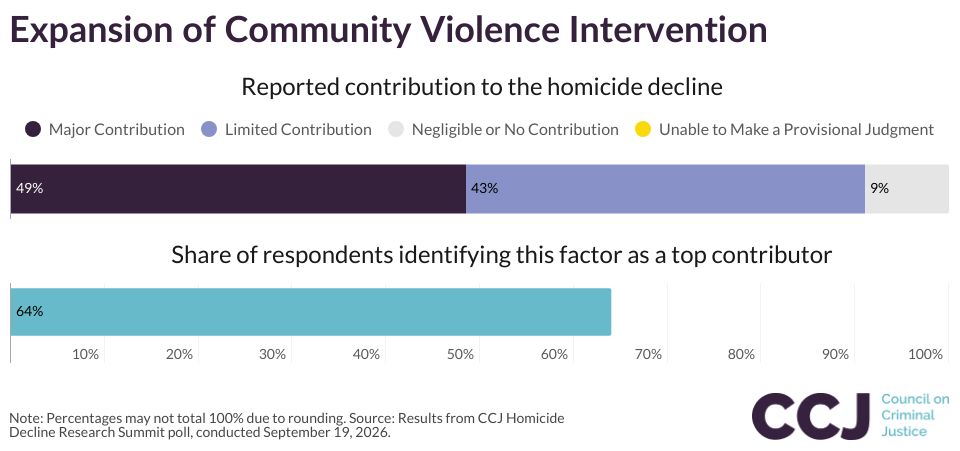
Community violence intervention (CVI) uses trusted community-based workers, often called “credible messengers,” to engage with people and groups at high risk of gun violence. Outreach workers mediate disputes, help people step away from immediate conflicts, connect individuals to services, and maintain contact over time. The potential homicide connection is that shootings are concentrated in small networks and places, so CVI aims to intervene before conflicts become shootings. Evidence is mixed, with more favorable findings for some participants than for neighborhoods overall. A randomized trial in Denver found lower levels of violent offending among participants, while evaluations in Baltimore found reductions in youth homicide and nonfatal shootings that were not statistically significant and varied across sites; studies in Washington, D.C., found no reductions in gun violence associated with CVI, and one found higher gun homicide in one neighborhood.2 CVI funding and infrastructure also expanded beginning in 2020 and 2021, before the national homicide decline. Among large city and county governments, 28% used American Rescue Plan Act funds for CVI, although about 70% of those investments were concentrated in five jurisdictions.3
The key questions are whether CVI expanded before and during the homicide decline among the people, networks, and neighborhoods where gun violence was concentrated, and whether places with greater CVI reach saw larger reductions in shootings and homicide.
Participant Comments
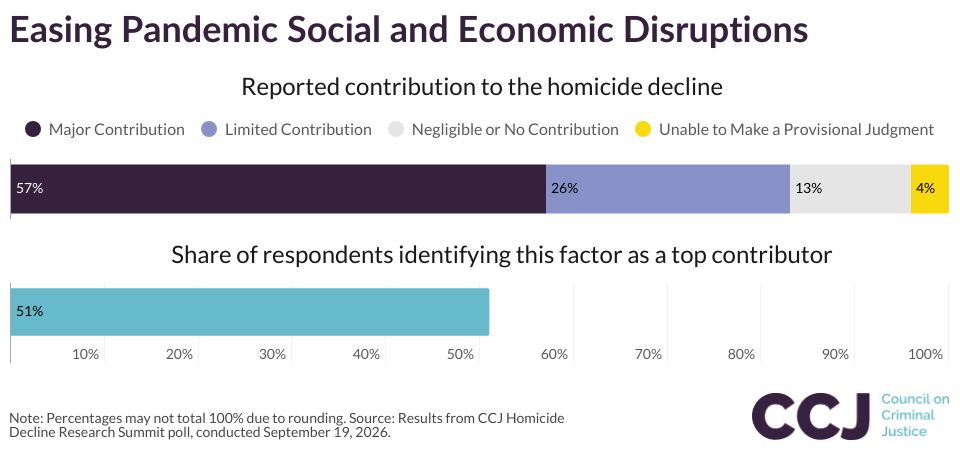
The COVID-19 pandemic disrupted employment, schooling, social contact, services, and daily routines across the U.S. The potential homicide connection is that these changes may have increased financial strain and reduced youth supervision or support, while shifts in mobility and social contact changed opportunities for violent offending and victimization. Firearm homicide rose 35% from 2019 to 2020, but research has not identified a single pandemic-related explanation for the increase.4 A study combining monthly data from 16 U.S. cities found that sharp increases in unemployment from March to July 2020 were associated with increases in firearm violence and homicide, while an Atlanta study linked school closures with more adolescent firearm injuries.5 Other research complicates the picture: A systematic review found no clear immediate homicide change following COVID-19 restrictions, and a 28-city study found that homicide was already elevated before restrictions began.6 Many pandemic disruptions were receding as homicide began to decline. Unemployment had returned to a level close to its pre-pandemic rate by April 2022, and schools were returning to in-person instruction during 2021, although COVID-related closures continued through the 2021–2022 school year.7
The key question is whether the easing of specific pandemic-related disruptions associated with the homicide increase helped shape the subsequent decline.
Participant Comments
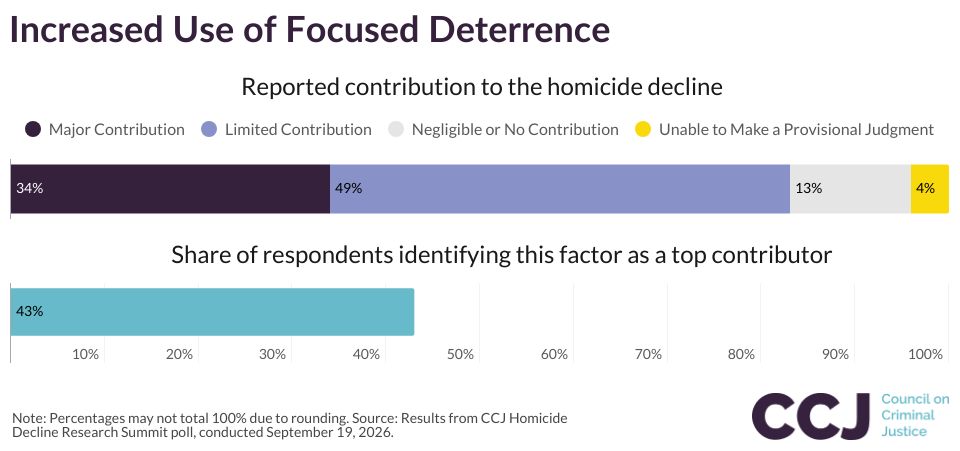
Focused deterrence identifies small groups and networks involved in serious violence and brings together law enforcement, service providers, and community members. Core components include analysis of local violence, direct communication with identified groups, offers of services and support, community anti-violence messaging, and targeted enforcement if violence continues. The potential homicide connection is that targeting small networks where shootings and homicides concentrate may change perceptions about enforcement, interrupting retaliation, and connect people to support. A 2026 review of 50 evaluations found that, across 28 studies measuring violent firearm crime, outcomes were 25% lower on average in focused deterrence groups than comparison groups.8 Results varied across the nine randomized trials in the review: five found significant reductions, two found mixed effects, and two found no significant overall effect. Site-specific evaluations found that shootings among treated groups in Philadelphia fell 39%, while in Baltimore shootings and homicides were one-third lower in the first district where focused deterrence was implemented than in comparable neighborhoods; after citywide implementation, Baltimore homicide was 60% below 2022 levels and 25% below a synthetic comparison by 2025.9
The key questions are whether these programs expanded or were rebuilt after 2022 in cities contributing most to the national decline, and whether outcomes among targeted groups were reflected in citywide homicide trends.
Participant Comments
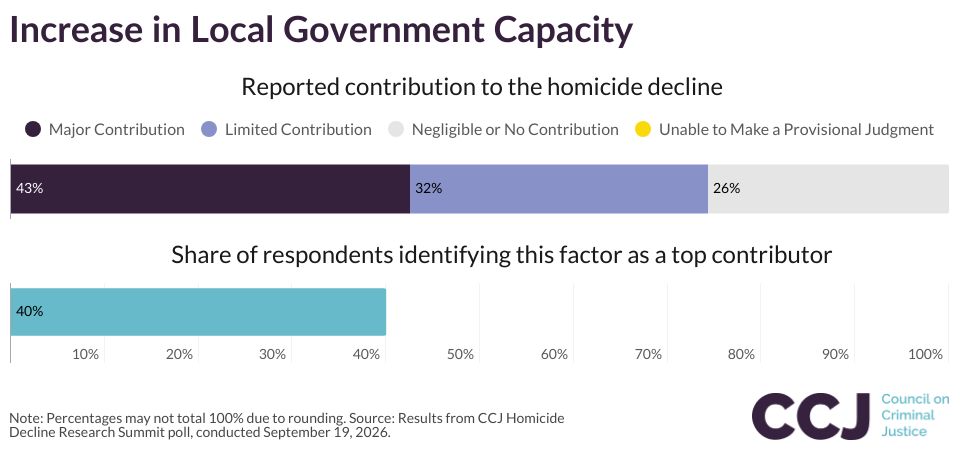
Local government capacity is the staffing, funding, and infrastructure cities and counties use to provide services, including public-safety and violence prevention work. The pandemic and measures taken in response to it disrupted that capacity, reducing government employment and interrupting institutions that regularly interact with people at elevated risk of violence. The potential homicide connection is that restoring staff and services could rebuild the structure, supervision, treatment, and prevention efforts that may reduce violence. State and local governments lost about 1.25 million jobs in spring 2020, and local government employment remained 555,000 jobs below its pre-pandemic level in July 2022. Employment then grew rapidly and returned to its pre-pandemic level in September 2023.10 The American Rescue Plan Act provided $350 billion to more than 30,000 governments for uses that included public services, staffing, behavioral health, economic supports, and community safety.11 By mid-2026, government employment was about 500,000 jobs above its pre-pandemic level.12 Whether that recovery affected homicide has not been tested directly.
The key questions are whether places that restored staffing and services more quickly saw larger subsequent homicide declines, and which parts of that recovery were most closely connected to reductions in violence.
Participant Comments
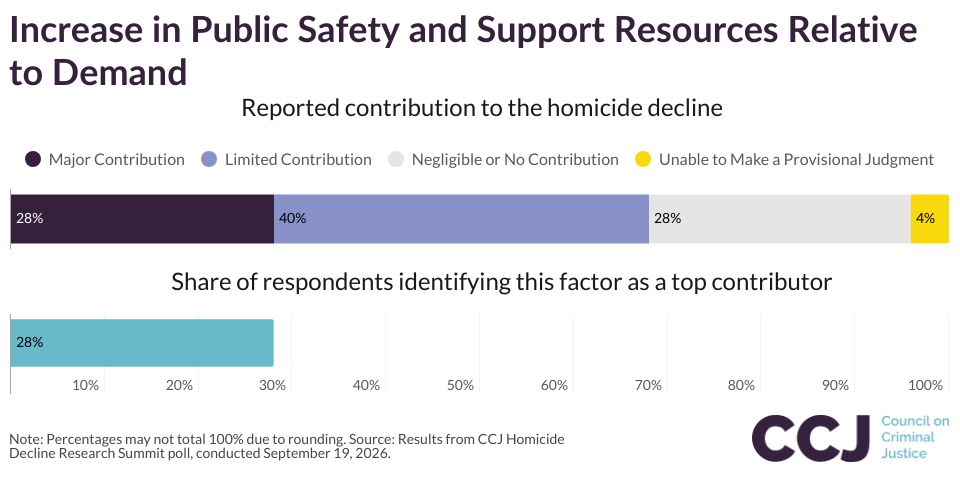
Public safety and service resources are the staff time and program capacity available to respond to crimes, cases, and people needing attention. As crime and justice-system involvement decline, those resources may be spread across fewer demands, increasing the time and support available per case or person. The potential homicide connection is that greater capacity could improve serious-crime investigations, supervision, reentry, and access to services. National indicators point to substantially less system demand than before the pandemic: Estimated arrests were 7.6 million in 2025, about 25% below 2019 levels, while long-term cohort research finds that younger generations are entering adulthood with less criminal involvement, contributing to smaller correctional populations.13 Research also suggests that workload can shape what agencies and providers are able to do. Heavier investigator caseloads have been associated with lower homicide clearance, while lower probation caseloads can allow more contact and intervention; research on desistance likewise emphasizes access to employment, housing, education, and other supports.14
The key question is whether demand fell relative to available capacity enough to increase the attention and support available per case or person, and whether that contributed to the homicide decline.
Participant Comments
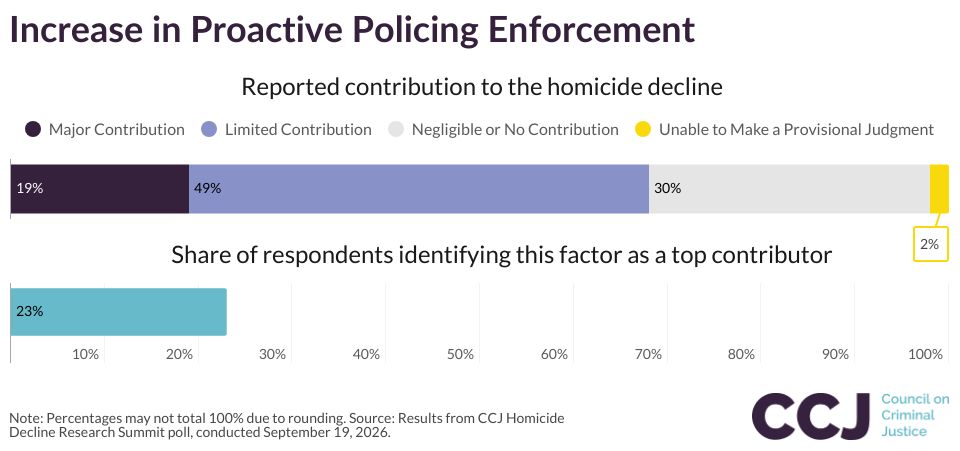
Proactive policing refers to officer-initiated police activity intended to prevent crime, including pedestrian and vehicle stops, patrols, and other discretionary enforcement. For homicide, the most relevant activities target illegal gun carrying and gun violence. The potential homicide connection is that these activities may increase the perceived likelihood of apprehension, deter illegal gun carrying, or interrupt situations that could become shootings. Several cities recorded sharp declines in discretionary police activity after George Floyd’s murder in 2020, as homicides and shootings also rose.15 Research on whether reduced police activity contributed to violence is mixed. In St. Louis, one analysis found that lower officer-initiated police activity was associated with higher homicide after Michael Brown was shot and killed by a police officer in Ferguson in 2014; the same study did not find that pattern across 60 large cities.16 A New York City study linked fewer police stops with increases in gun, non-domestic, and gang homicides.17 In Minneapolis, a 2026 study estimated that reduced stops accounted for about 25% of the homicide increase following Floyd’s murder.18
The key questions are how officer-initiated enforcement aimed at gun carrying and shootings shifted after 2022 in places contributing most to the national homicide decline, and whether patterns in that activity were associated with the size of local declines in homicide.
Participant Comments
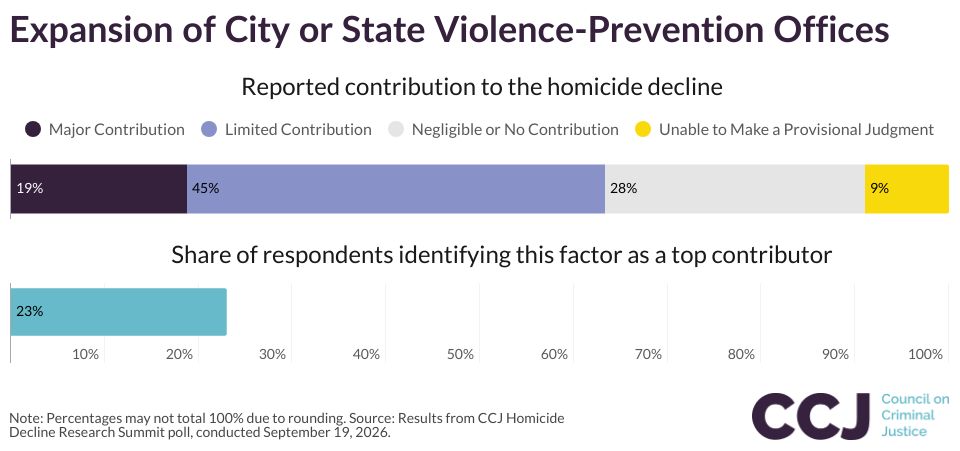
State and local violence-prevention offices are dedicated government units that coordinate violence-reduction work. Local offices often connect police, community organizations, public health, victim services, hospitals, and other partners; state offices may also coordinate across jurisdictions, administer grants, and support data and research. The potential homicide connection is organizational: these offices may help partners align strategies, share information, direct resources, and carry out interventions more consistently. Evidence is primarily about the strategies these offices coordinate rather than office creation itself. In Baltimore, a coordinated Group Violence Reduction Strategy involving the mayoral violence-prevention office was associated with a citywide homicide rate about 25% below comparison cities, although the analysis cannot separate the office’s role from the programs, policing, services, and other changes it coordinated.19 An international systematic review found that violence-observatory models were associated with reductions in homicide in high-violence settings.20 Violence-prevention offices also became a more common after 2020, as jurisdictions expanded civilian capacity to coordinate these efforts.21
The key questions are whether governments strengthened this coordinating capacity from 2022 to 2026, particularly in places with large homicide declines, and whether that was associated with more effective violence-reduction efforts.
Participant Comments
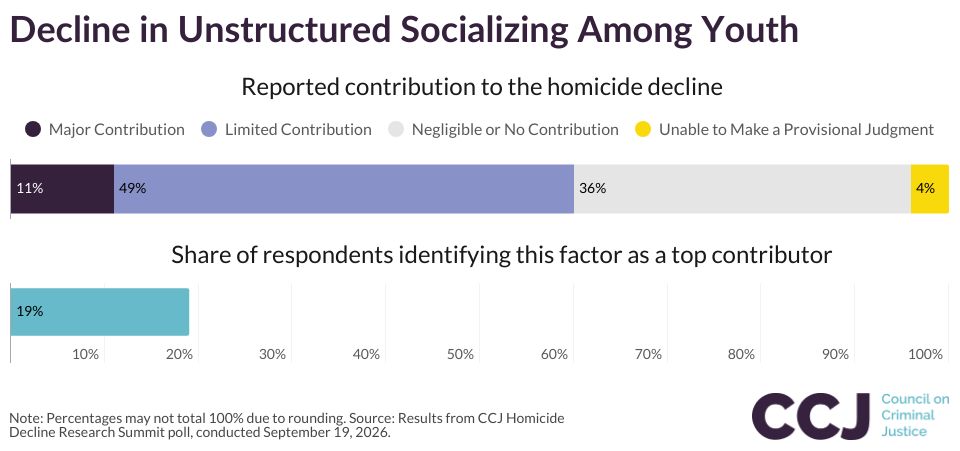
Unstructured socializing is time young people spend with peers without adult supervision or organized activities—hanging out, driving around, going to parties, or otherwise spending time together on their own. The potential homicide connection is that a decline in time spent with peers away from adult supervision could reduce opportunities for group offending, conflict, or exposure to violence. Youth violence often involves peers: Recent data shows that about 60% of young people ages 15 to 19 who were accused of murder were involved with at least one other person.22 Research has also linked unstructured socializing to gang involvement, violent offending, and exposure to violence.23 Measures of teen independence and in-person socializing have declined over the past two decades, while youth aggravated assault fell about 35% between 2009 and 2024.24 Homicide has not always followed the same pattern. From 2019 to 2021, unstructured socializing and general youth delinquency both fell sharply, while youth involvement in homicide rose.25 Most research on unstructured socializing has examined delinquency generally rather than homicide specifically.
The key questions are whether young people at greatest risk of serious violence spent less time socializing with peers away from adult supervision after 2022, and whether that shift contributed to homicide reductions at a scale that affected the national trend.
Participant Comments
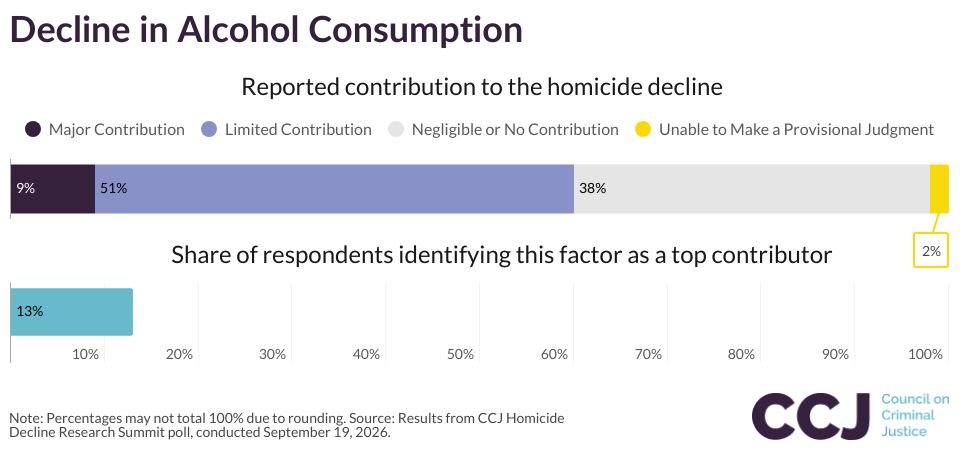
Alcohol consumption may affect homicide by changing how conflicts unfold. The potential homicide connection is that alcohol can impair judgment, lower inhibitions, and increase impulsivity or aggression, increasing the chance that conflicts become serious or lethal. Reviews find that alcohol is present in a substantial share of homicides and that alcohol exposure is strongly associated with several forms of firearm violence and related risk.26 Recent national indicators point to lower alcohol consumption: Per capita consumption fell 1.2% from 2022 to 2023, with declines in 41 states and the District of Columbia, while the share of U.S. adults reporting that they drink alcohol fell to 54% in 2025, the lowest level in Gallup’s trend dating to 1939.27 These measures do not show whether declines were concentrated in heavy drinking or in settings where alcohol is more likely to be involved in serious violence.
The key question is whether recent declines in alcohol use occurred among the people and in the contexts most connected to homicide and other serious violence.
Participant Comments
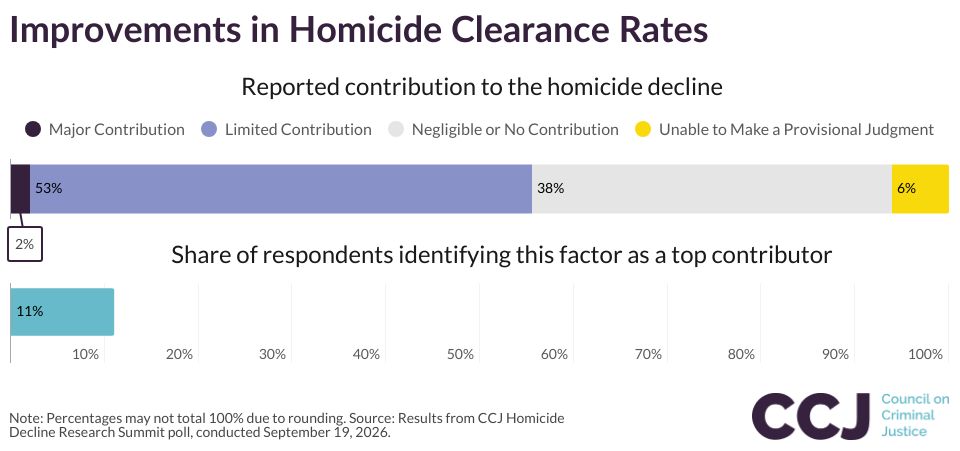
Homicide clearance rates measure the share of reported homicides that police solve through an arrest or, in some cases, by “exceptional means”—when police identify the person responsible and have enough evidence to make an arrest, but cannot do so for reasons beyond their control, such as the person’s death. The potential homicide connection is that solving more homicide and shooting cases can lead to arrests that prevent repeat violence, increase the perceived likelihood of apprehension, and increase willingness to cooperate with investigations. Research generally finds that crime is more responsive to the likelihood of apprehension than to punishment severity, while homicide-specific research links higher actual and perceived clearance rates with greater stated willingness to cooperate with investigations.28 The national homicide clearance rate reported by the FBI rose from 52% in 2022 to 61% in 2024 and 69% in 2025.29 Annual clearance rates, however, can include earlier homicides cleared during the current year, and falling homicide may itself raise clearance by reducing investigative caseloads.30
The key question is whether the likelihood of solving newly occurring homicides increased as homicide fell, or whether annual clearance rates rose mainly because fewer cases were competing for investigative resources or older cases were being cleared.
Participant Comments
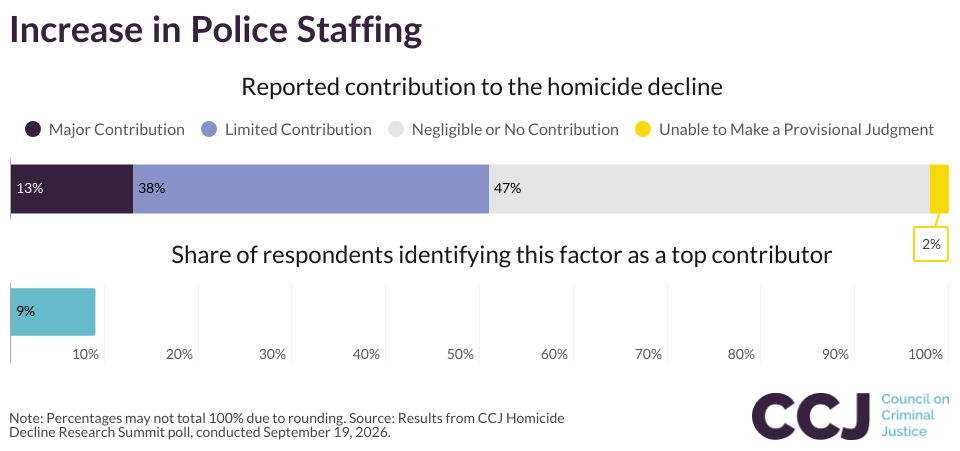
Police staffing refers to the number of sworn officers employed by law enforcement agencies. The potential homicide connection is that more officers may increase police presence and enforcement capacity, raising the perceived likelihood of apprehension and deterring violence. Research generally finds that larger police forces reduce crime, including homicide; one study estimated that a 10% increase in police staffing was associated with a roughly 6% reduction in homicide.31 During the recent homicide rise and decline, an analysis of FBI data for 167 large cities found that sworn staffing fell about 6% from 2019 to 2023 and then stabilized in 2024; homicide rose by roughly 40% between 2019 and 2022 before falling substantially over the next two years.32 Based on the historical relationship between staffing and homicide, a staffing change of that size would correspond to about a 3% to 4% change in homicide. Across cities, changes in staffing between 2022 and 2024 showed little relationship to changes in homicide. Research suggests that where and how officers are deployed can matter, so total staffing may not capture changes in police presence or activity.33
The key question is whether staffing changes of the size observed during the homicide decline translated into changes in police presence or enforcement capacity where serious violence was most likely to occur.
Participant Comments
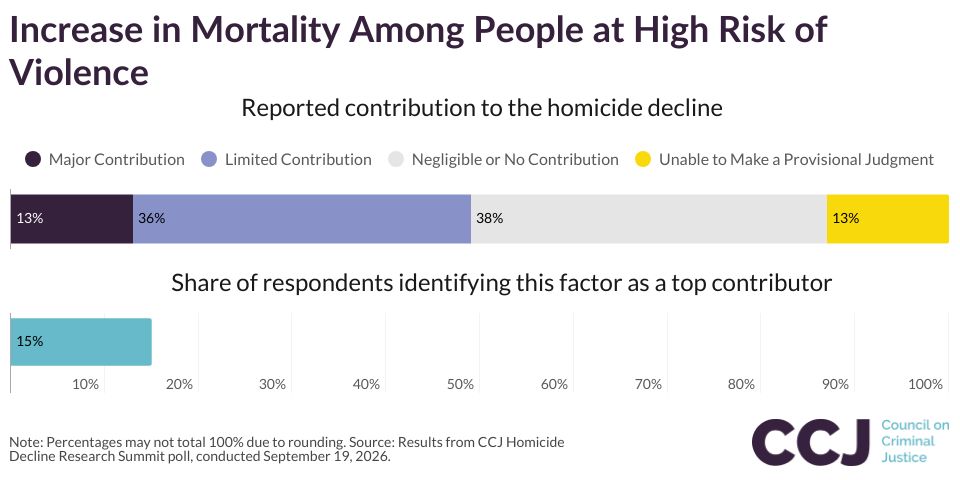
During 2020 and 2021, the U.S. recorded roughly 1 million more deaths than expected, including deaths from COVID-19, drug overdose, suicide, motor-vehicle crashes, and homicide.34 The potential homicide connection is that some of those deaths may have occurred among people in the small networks where serious violence is concentrated, leaving fewer people at risk of later violence, either as victims or as people who commit violent crimes. That pathway depends on who died: Violence is concentrated within relatively small networks, and conflicts can persist even after particular people die.35 Most excess deaths were COVID-19 fatalities among older adults, while overdose and suicide deaths were concentrated in middle adulthood.36 In Minneapolis and St. Paul, excess homicides were concentrated in census tracts with the greatest disadvantage, while homicide accounted for only a small share of excess mortality overall.37 The mortality wave peaked in 2020 and 2021, before the steepest homicide declines. Lethality also fell as homicide declined, so fewer homicides could reflect fewer shootings, fewer shootings becoming fatal, or both.38
The key questions are whether people who died during the mortality wave were disproportionately drawn from the networks most likely to be involved in later shootings, and whether those networks subsequently experienced fewer shootings, rather than only fewer fatal outcomes.
Participant Comments
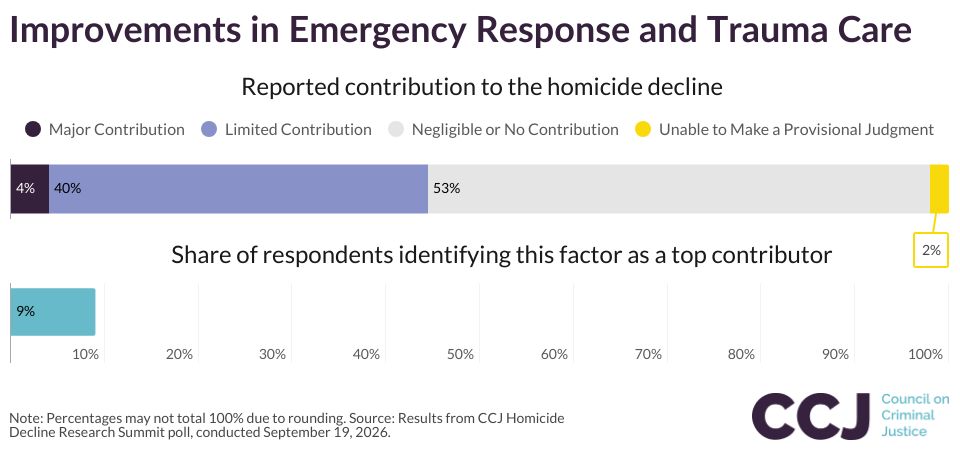
Emergency response and trauma care can affect homicide rates by changing whether people survive serious injuries, especially shootings. The potential homicide connection involves reduced lethality, rather than fewer violent incidents: faster response, bleeding control, trauma-center access, transfusion, surgery, and critical care can increase survival after serious assaults. A 2023 review describes advances across prehospital and hospital trauma care, including hemorrhage control and transfusion practices.39 Recent U.S. evidence also documents declining firearm-injury mortality along with changes in care and access. In a health-record study spanning the period from 2004 to 2023, mortality among firearm-injury patients fell from 12% to less than 1%, while transfusion use increased from 2% to 11%; the study does not, however, establish what caused the decline in firearm-injury mortality.40 In Chicago, the opening of a Level I trauma center in 2018 shortened travel time for transported victims by 9.5 minutes and was associated with a 4% decrease in firearm mortality in the surrounding service area.41
The key questions are whether the lethality of shootings and other serious assaults declined from 2022 to 2026, and whether advances in emergency response and trauma care contributed to that decline.
Participant Comments
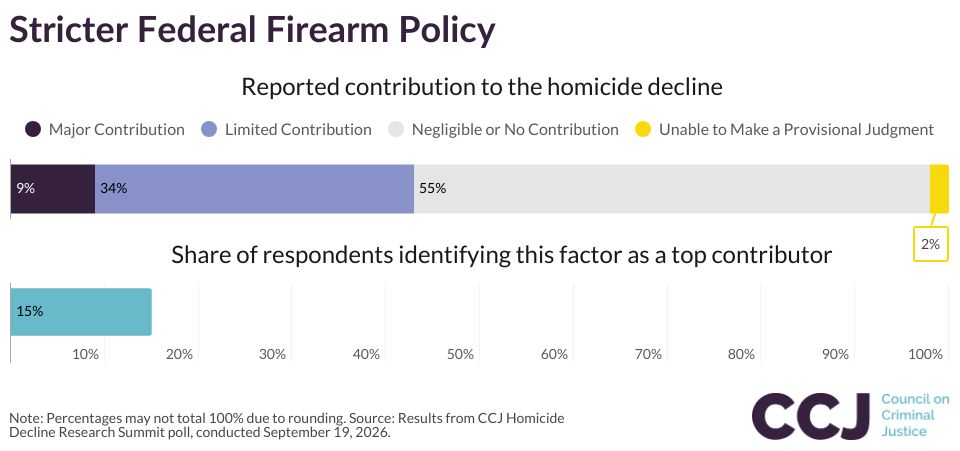
Federal firearm policy includes laws, regulations, and enforcement practices governing who can legally buy or possess guns and how firearms are sold and transferred. The potential homicide connection is that stricter laws, regulations, or enforcement may make it harder for people at elevated risk of violence to obtain firearms. Federal policy changed in several ways in 2021 and 2022. The federal government increased oversight of gun dealers that violated sales rules; brought some privately made “ghost guns” under federal firearm regulations, requiring serial numbers and background checks in covered sales; created new federal crimes for gun trafficking and buying a gun for someone who cannot legally purchase one; expanded restrictions involving some domestic-violence cases; and added background-check requirements for buyers under 21.42 Firearms accounted for about 80% of U.S. homicides in 2020 and 2021, and most of the subsequent decline has occurred in gun homicides.43 Evidence on these changes remains limited. One study of the dealer-enforcement policy found larger firearm-homicide declines where ATF offices issued more warning letters to gun dealers; several other policies have not yet been evaluated.44
The key question is whether federal policy changes beginning in 2021 and 2022 changed firearm access or dealer behavior among the people and markets most connected to firearm homicide in ways that contributed to the decline.
Participant Comments
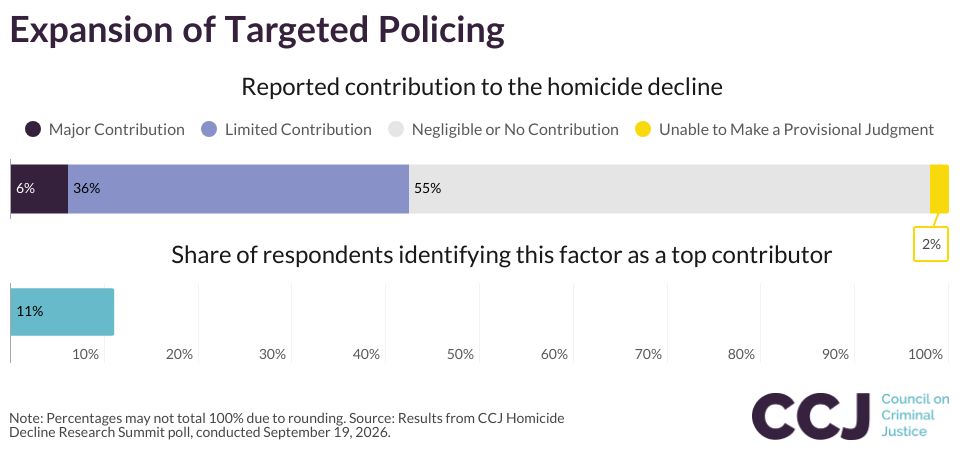
Targeted policing directs police resources toward the relatively small number of places, people, and networks where serious violence occurs. Hot spots policing, one common approach, focuses patrol and problem-solving on small geographic areas with high levels of crime. The potential homicide connection is that concentrating police activity in these places may increase the perceived likelihood of apprehension and interrupt violent activity. Research generally finds that hot spots policing reduces violence at treated locations. One review found that violent crime was 19% lower, on average, in places where hot spots policing was used.45 In a randomized St. Louis study, firearm assaults fell 79% in hot spots receiving officer-initiated enforcement, compared with a 24% drop in comparison locations.46 Dallas experienced a 21% citywide reduction in violent crime relative to comparison cities after adopting a strategy that initially centered on hot spots policing, although its broader crime plan included other targeted approaches.47 Most evaluations of hot spots policing focus on violent crime or gun assaults at targeted locations, rather than homicide specifically.
The key questions are whether hot spots policing expanded or intensified during the homicide decline in places accounting for substantial firearm violence, and the extent to which changes in violence at those locations contributed to lower homicide at the city level.
Participant Comments
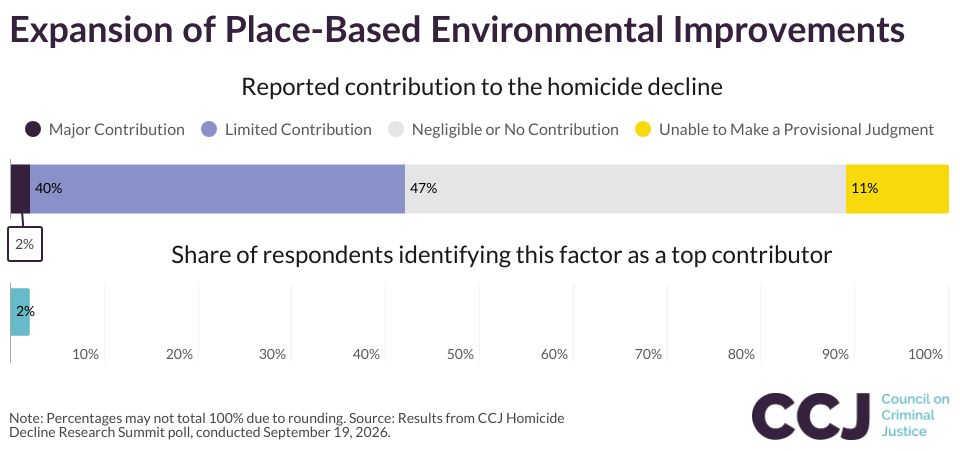
Place-based environmental improvements change neighborhood spaces by greening vacant lots, securing abandoned buildings, improving lighting, or maintaining public areas. The potential homicide connection is that changing physical conditions at places where violence is concentrated may increase visibility, change how residents use space, and reduce opportunities for shootings or other serious violence. Most homicide-specific evidence concerns vacant-property remediation. Across randomized and quasi-experimental studies, greening vacant lots and securing abandoned buildings have generally been associated with reductions in firearm violence, although effects vary by intervention. A meta-analysis of eight studies found reductions in firearm violence of roughly 5% to 6% after vacant-lot greening or the initiation of community gardening, while mowing alone had no pooled effect.48 Philadelphia trials also found fewer shootings after lot remediation and fewer gun assaults after abandoned-house remediation. Results are less consistent for lighter-touch improvements: A 2023–2024 Philadelphia street-cleaning trial reduced litter but not gun violence significantly, while a street-lighting review found reductions in total crime but not violent crime.49 Federal pandemic-recovery funds were authorized for use on vacant-property cleanup and remediation, but there is no national measure of how widely these interventions expanded.50
The key questions are whether these improvements expanded in places with concentrated gun violence and whether shooting reductions followed.
Participant Comments
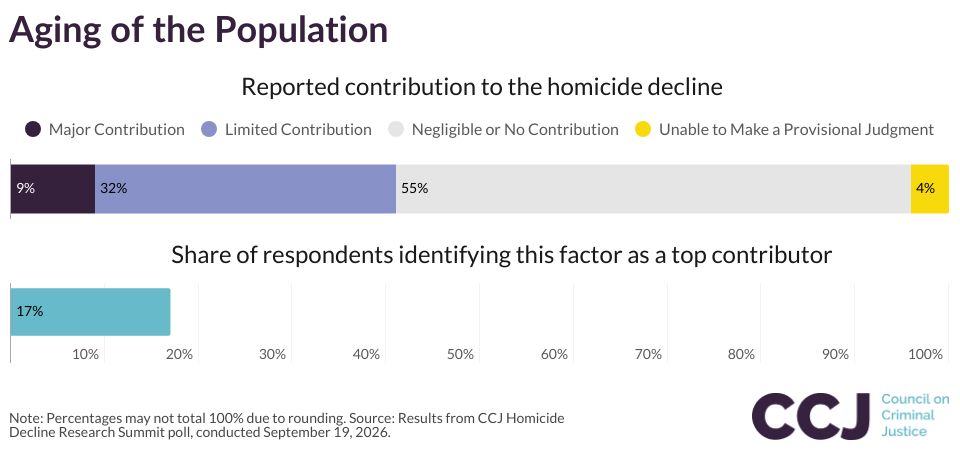
The U.S. population has gradually shifted toward older age groups. The potential homicide connection is the age structure of the population: Because rates of serious violence generally decline with age, a population with fewer people in younger age groups may have lower homicide rates even if age-specific rates do not change. Young adults are overrepresented on both sides of violent incidents. In 2023, people ages 18 to 29 made up 18% of the population, but accounted for 33% of violent-crime victims and 23% of people identified as responsible for violent incidents; in 2022, homicide rates were highest among people ages 20 to 24.51 Age structure has shifted gradually rather than uniformly across younger adults: The share of Americans aged 19 to 25 fell from 9.4% in 2013 to 8.6% in 2024, while the share aged 26 to 34 changed little.52 Because demographic change is gradual, its relationship to homicide may unfold over a longer period rather than beginning with the recent decline.
The key question is how much the decrease in the share of younger people contributed to the homicide decline, compared with decreases in homicide rates among people of the same ages.
Participant Comments
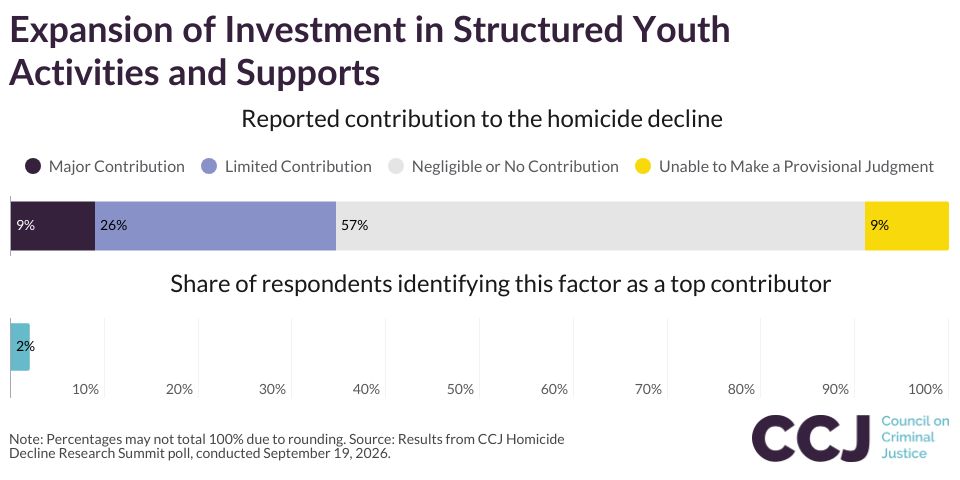
Structured youth activities and supports include summer employment, mentoring, and afterschool and summer programs that provide supervised activities, relationships with adults, and connections to school or work. The potential homicide connection is that these programs may reduce unsupervised time and opportunities for conflict while providing skills and relationships that can influence violent behavior after participation ends. Most research measures violent arrests or arraignments, delinquency, or antisocial behavior, rather than homicide. Across summer employment programs, randomized evaluations in Chicago and Boston found reductions in violent-crime arrests or arraignments, including effects that extended beyond the summer; a 2024 systematic review, however, found no overall reduction in violent arrests, charges, or other justice-system outcomes across programs.53 Research on broader afterschool programs is also mixed: A meta-analysis of 12 studies found a small, statistically nonsignificant reduction in delinquency or antisocial behavior.54 Federal pandemic-recovery funds supported expanded afterschool and summer offerings beginning in 2021, but national afterschool participation was 13% in 2025, compared with 18% in 2014.55
The key question is whether increased investment in structured youth activities and supports led to greater participation among young people at elevated risk of serious violence during the homicide decline.
Participant Comments
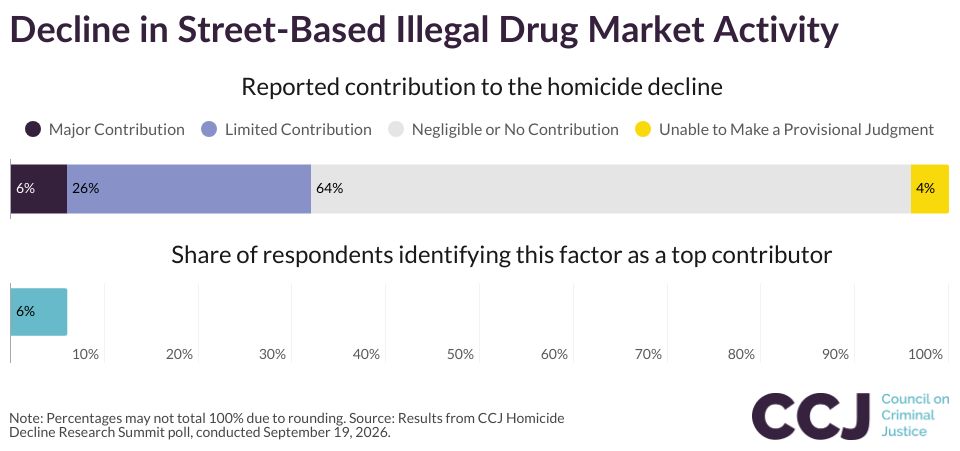
Street-based illegal drug markets involve people buying and selling drugs in person, often in public places or other face-to-face settings. The potential homicide connection is that disputes over territory, debts, or drug quality can become violent, and sellers carrying cash or drugs can be targets for robbery. People involved in these markets may also carry guns for protection, creating more opportunities for disputes or robberies to escalate into lethal violence. During the crack cocaine era of the 1980s, street markets expanded and drew more young people into drug selling; increases in youth homicide followed the arrival of crack markets across cities.56 Today’s drug markets differ. Fentanyl and methamphetamine play larger roles, and some sales have shifted online, although cash-based markets still account for most retail transactions involving illegal stimulants and opioids.57 It is difficult to track whether street-based activity has changed in recent years. A federal program that measured drug use and spending among people who were arrested ended in 2013, and the most recent national estimates of frequent drug use and retail spending are from 2016.58
The key questions are whether street-based drug selling declined during the homicide drop in places where drug-market violence was concentrated, and whether violence connected to those markets changed as well.
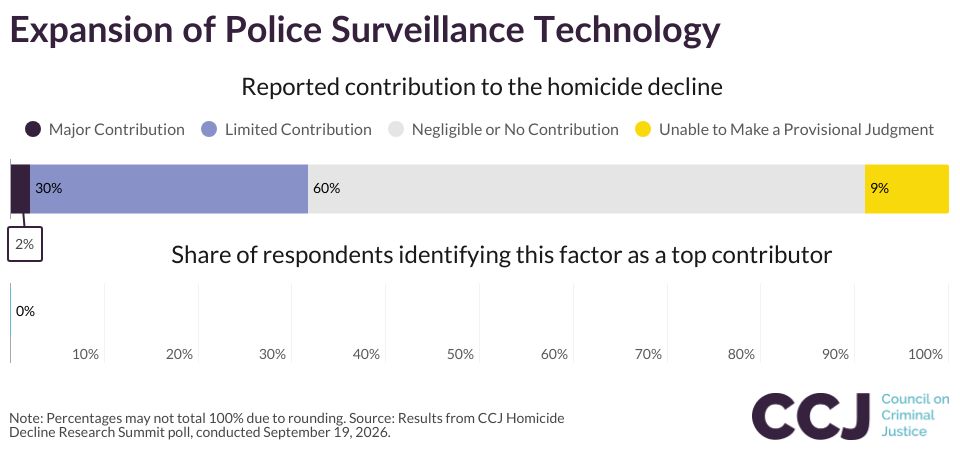
Police surveillance technology includes closed-circuit television (CCTV) cameras that record or monitor public places, automated license plate readers (ALPRs) that scan vehicle plates, and real-time crime centers that combine information from multiple technologies. The potential homicide connection is that surveillance may deter violence by increasing the perceived likelihood of detection or may help police identify and apprehend people involved in serious violence. A systematic review found that CCTV was associated with a 13% reduction in crime overall but no significant reduction in violent crime. Crime reductions were larger when cameras were actively monitored and paired with police patrol or other interventions.59 Studies of ALPRs have generally found no additional deterrent effect beyond police patrol, and one study found no significant change in shooting clearance rates after a major expansion.60 Real-time crime centers combine technologies such as cameras, ALPRs, and gunshot detection with crime analysis and police response. In Chicago, real-time crime centers were associated with about a 5% increase in violent-crime clearance rates, and nonfatal shootings in districts with an active center were 19% to 24% more likely to be cleared.61 By 2025, about 300 law enforcement agencies—less than 1% of the U.S. total—operated real-time crime centers.62
The key question is whether surveillance expanded from 2022 to 2026 in ways that increased detection, police response, or the likelihood of solving serious violence.
Participant Comments
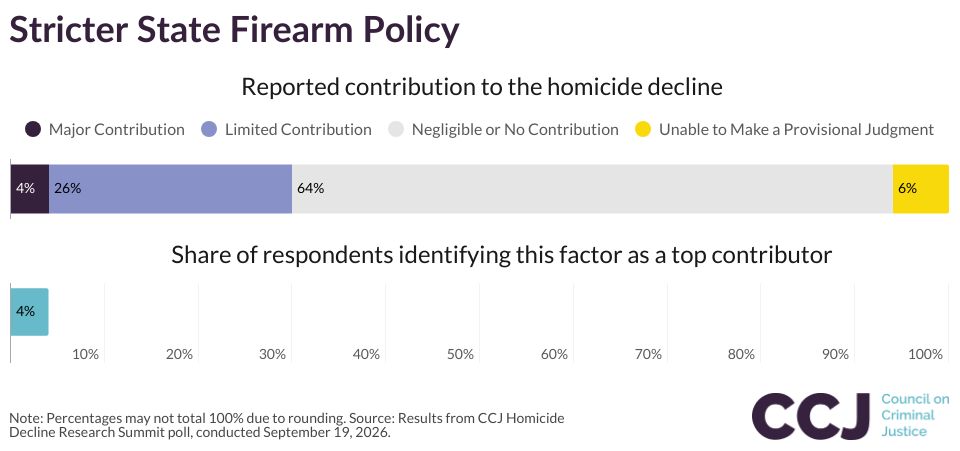
State firearm policy governs who can buy and possess guns, how firearms are sold, and when they may be carried in public. While federal law sets a national baseline, states may add some restrictions and, in many states, limit further regulation by local governments. State approaches therefore vary widely, and individual states can tighten some rules while loosening others. The potential homicide connection is that laws affecting firearm access and carrying may change how readily guns are available during potentially violent encounters. A 2024 study found that permit-to-purchase laws were associated with 18% lower firearm homicide rates, while universal background checks without a permit requirement were not associated with lower homicide.63 A 2024 research review found moderate evidence that firearm prohibitions tied to domestic violence restraining orders reduced intimate-partner homicide, and limited evidence that waiting periods reduced firearm homicide. It also found supportive evidence that less restrictive “shall-issue” concealed-carry laws increased firearm homicide, while evidence on permitless carry was inconclusive.64
The key questions are which state firearm policies were in place or changed before and during the homicide decline, how those policies differed across states contributing most to the national decline, and how firearm homicide changed as policies had time to take effect.
Participant Comments
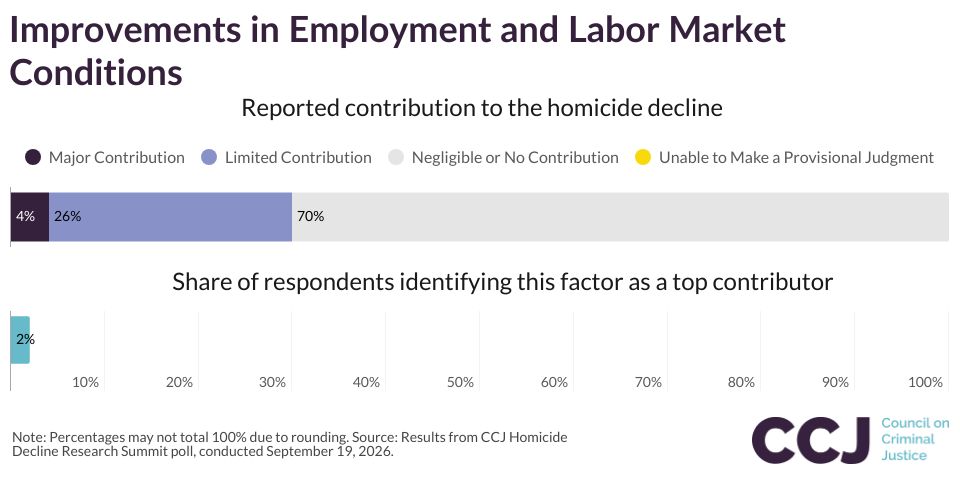
Improved employment and labor market conditions can increase access to work, earnings, and economic stability. The potential homicide connection is that increased access to jobs or higher wages may reduce financial strain, change daily routines, and increase the benefits of legal work relative to illegal activity. Research generally finds that better labor-market opportunities are associated with lower crime, although relationships are more consistent for property crime and robbery than for homicide and other serious violence.65 U.S. studies also find that employment effects vary across places, populations, and types of work, making national unemployment or wage measures an incomplete indicator of the conditions experienced by people at elevated risk of violence.66 When homicide began declining in 2022, employers were competing for a relatively limited supply of workers, job openings were plentiful, and wages were rising relatively quickly.67 Over the next several years, job openings declined and wage growth slowed as the labor market moved closer to pre-pandemic conditions, while homicide continued to fall.68
The key question is whether improvements in jobs, wages, or labor demand reached people and places at elevated risk of serious violence during the homicide decline.
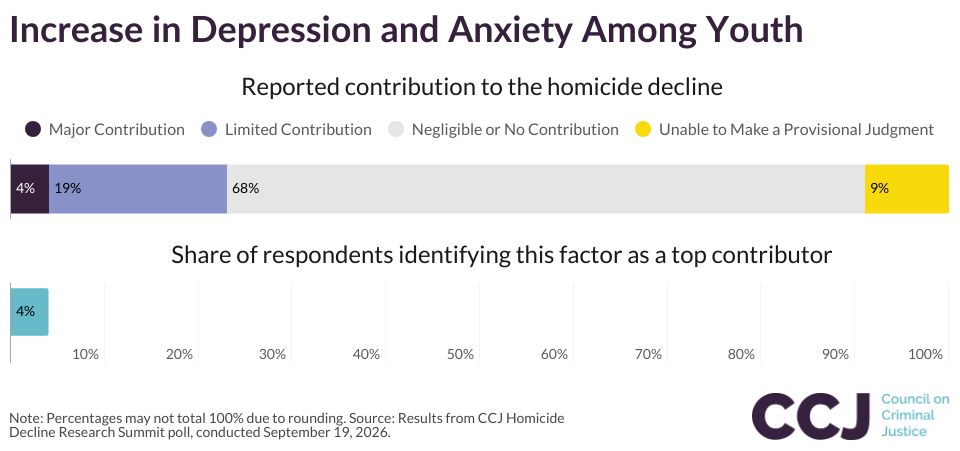
Depression and anxiety among youth rose before and during the COVID-19 pandemic, with diagnosis rates highest among older adolescents and young adults.69 The potential homicide connection is that worsening depression and anxiety may change how young people interact with peers and respond to stress, affecting exposure to or participation in interpersonal conflict. Across qualitative studies of young people with depression, social withdrawal and loneliness were among the most commonly reported experiences, which could alter how much time youth spent in situations where conflicts begin or escalate.70 Research does not show a consistent relationship between depression and later violence: A 2025 review of 36 longitudinal studies found positive, null, and mixed results.71 Depression and anxiety can also coexist with irritability and anger, which for some young people can include emotional outbursts or aggressive responses to perceived threats.72 Some national indicators also improved during the homicide decline. Persistent sadness or hopelessness among high school students fell from 40% in 2023 to 33% in 2025, while major depressive episodes among people ages 18 to 25 fell from 20% in 2022 to 14% in 2025.73
The key questions are how changes in depression and anxiety affected behavior among young people at highest risk of serious violence, whether those effects increased or reduced exposure to interpersonal conflict, and how their timing aligns with the homicide decline.
Participant Comments
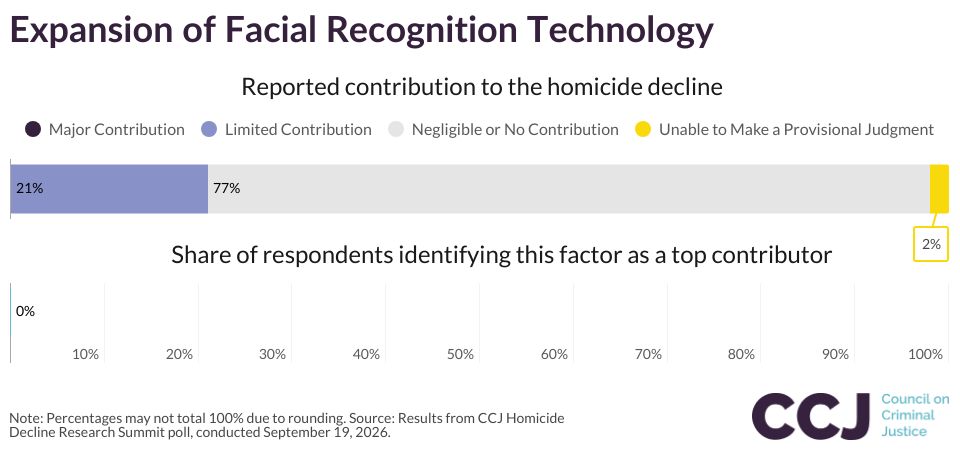
Facial recognition technology compares face images against databases to help police identify people, typically as an investigative lead rather than a standalone basis for arrest. The potential homicide connection is that facial recognition may help identify people from crime-scene images, support arrests in homicide and shooting cases, prevent repeat violence through incapacitation, or increase the perceived likelihood of detection and apprehension. One quasi-experimental study of 268 U.S. cities from 1997 to 2020 found that police adoption of facial recognition technology was associated with a 14% reduction in homicide; effects on overall violent crime were not statistically significant in the primary model.74 Recent systematic and scoping reviews identify relatively few studies examining facial recognition’s effects on investigations or crime outcomes, and findings remain mixed.75 In addition, national data do not show how police use of facial recognition may have changed during the homicide decline.
The key question is whether expanded use of facial recognition in serious-violence investigations from 2022 to 2026 was associated with more identifications or apprehensions in homicide and shooting cases.
Participant Comments
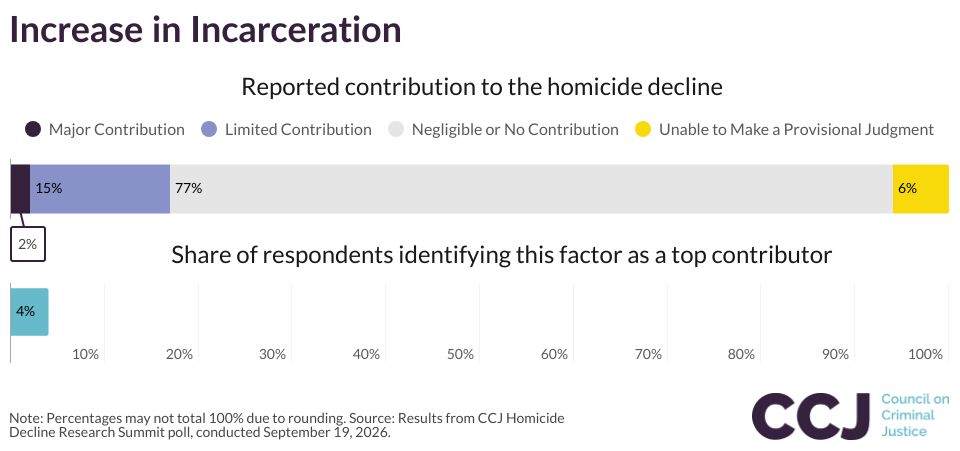
Incarceration refers to confinement in jail or prison. The potential homicide connection is that confinement can prevent people from committing violence in the community, while the prospect of confinement may deter violence if people believe punishment is likely and will come quickly. A National Academies review concluded that incarceration likely reduced crime overall, but could not estimate the size of the effect.76 Incarceration fell sharply in 2020 and 2021 and then partially rebounded, although prison and jail populations have remained below 2019 levels.77 Between the 2021 low point and the most recent data from 2023 and 2024, about 93,000 more people were confined on an average day, while homicides fell by about 6,000. Based on observed rates of serious offending, the additional confinement could account for 0.1% to 3.1% of that decline.78 Jail populations largely finished rebounding in 2022, before the steepest homicide declines. Research suggests that certainty of punishment matters more than severity, but national data do show how much the likelihood of detention following arrests changed during this period.79
The key questions are whether the post-pandemic rebound in confinement made punishment more certain or faster for people involved in serious violence, and whether that change contributed to the homicide decline.
Participant Comments
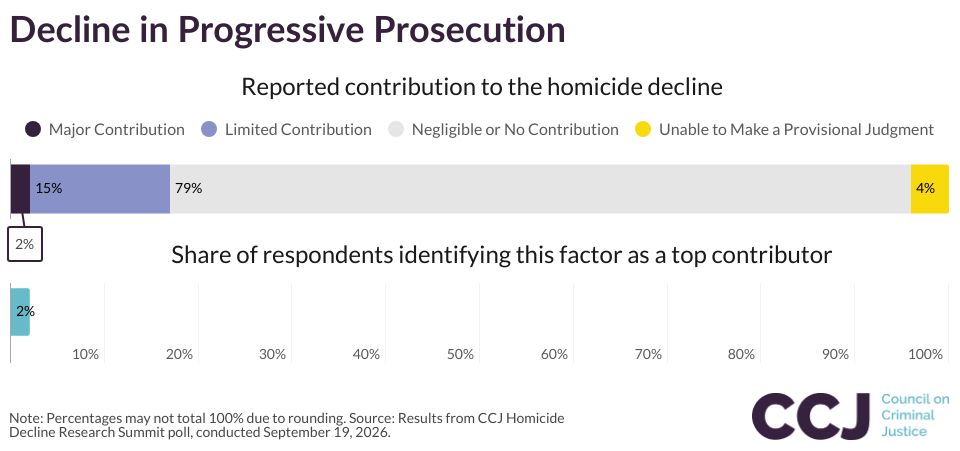
Progressive prosecution is an umbrella term for a set of locally implemented reforms, rather than a single policy, that can include declining some low-level cases, expanding diversion, reducing use of cash bail, and limiting some charging or sentencing practices. The potential connection to homicide is not one-directional: Reduced prosecution or punishment may lessen deterrence or incapacitation, while reducing low-level system contact may avoid disruptions to employment, housing, treatment, or family ties—or allow prosecutors to direct more resources toward serious violence. Recent research has not found a consistent effect on violent crime. One working paper found that reform-minded prosecutors reduced charging and convictions primarily for nonviolent misdemeanors, with no statistically significant changes in reported overall, violent, property, or homicide crime rates.80 A study of the 100 largest counties covering the 2000 to 2020 period found higher property and total index crime after progressive prosecutors took office, but no reliable overall effect on violent crime.81 The movement expanded substantially during the 2010s, but the policies adopted vary across offices.82
The key question is whether prosecutorial changes during the decline affected serious violence directly—through charging, detention, pleas, or witness cooperation—or indirectly by freeing time and resources to focus more on homicide, shootings, and other high-harm cases.
Participant Comments
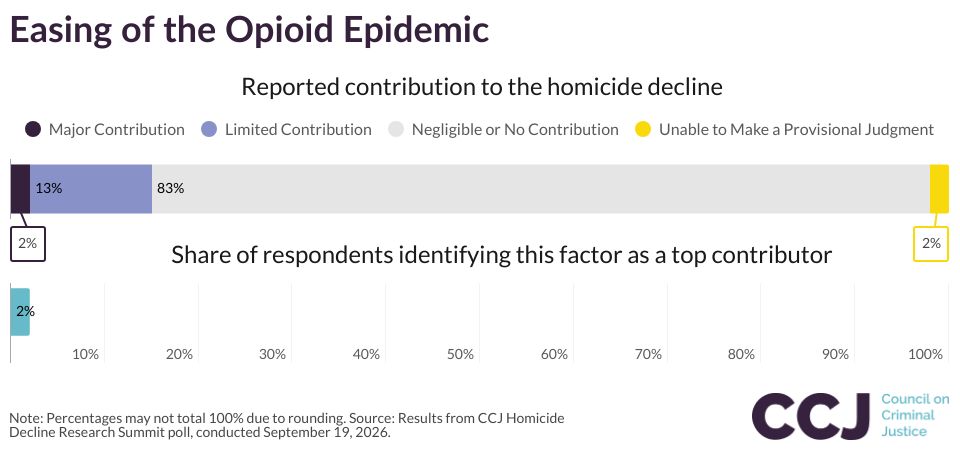
The opioid epidemic refers to widespread opioid use disorder and fatal overdoses, driven in recent years largely by illicit fentanyl. The potential homicide connection is indirect: Financial pressures associated with severe opioid addiction can lead to theft, robbery, or other crimes that sometimes become violent. Opioids themselves are depressants and are not associated with increased aggression, unlike methamphetamine, alcohol, and PCP.83 National survey data show that the share of the population with opioid use disorder remained around 2% in recent years, even as fatal overdoses fell sharply after 2022.84 The two measures can move differently because overdose deaths can fall when opioid use becomes less likely to be fatal, without a corresponding decline in addiction. Naloxone, which can reverse an overdose, has become much more widely available, with distribution rising from 7.7 million units in 2018 to 29.7 million in 2023.85 The geography of the two trends also differed: Overdose trends varied substantially across regions and states, while homicide declined more broadly.86
The key questions are whether opioid use disorder or addiction-related financial pressures declined after 2022 among people and drug markets most connected to serious violence, and whether changes in those concentrated settings contributed to the national homicide decline.
Participant Comments
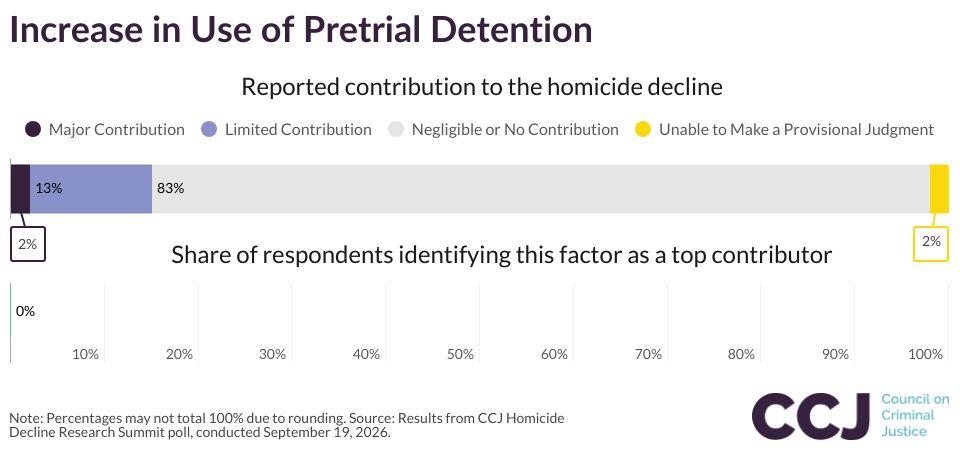
Bail reform changes how courts determine who is released or detained before trial, often by reducing reliance on money bail or changing when detention is available. The potential homicide connection can run in different directions: Greater detention can reduce offending while people are confined and may deter some offending, but detention can also disrupt housing, employment, treatment, and family ties in ways associated with later offending. Research reflects these competing pathways: Detention reduces offending while cases are pending, but some studies find those short-term effects are offset by higher offending after release.87 Policy evaluations, including quasi-experimental analyses in New York and New Jersey, generally have not found increases in violent crime, firearm violence, or homicide attributable to bail reforms.88 During the homicide decline, pretrial policy did not move in a single direction. New York, for example, expanded the circumstances in which some defendants could be detained, while Illinois eliminated money bail statewide but retained detention for certain cases.89
The key questions are whether greater use of pretrial detention reached people at elevated risk of serious violence and whether those changes were followed by reductions in serious violence.
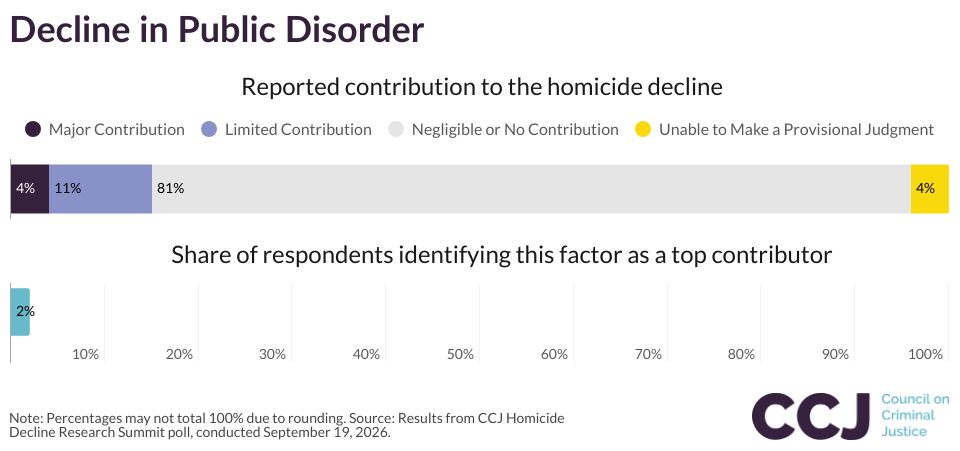
Public disorder includes visible activity in shared spaces; such activity ranges from public intoxication or drug use to fights, disturbances, and other nuisance behavior. The potential homicide connection is that lower levels of recurring disorder may change how public spaces are used and monitored and reduce settings where conflicts or other serious violence can develop. Research has not established that disorder itself causes violence. A large Chicago study found that disorder and violent crime largely reflected common neighborhood conditions, while a review of 96 other studies found no consistent evidence that disorder increases aggression.90 Intervention research points to a somewhat different relationship: A 2024 meta-analysis found reductions in violent crime when police and communities addressed recurring disorder problems, with larger effects for community and problem-solving approaches than for more enforcement-focused tactics.91 There is no consistent national measure showing whether public disorder is increasing or decreasing, and common indicators such as complaints, calls for service, and enforcement activity also reflect reporting and policing practices.92
The key question is whether reductions in recurring public disorder were followed by lower levels of serious violence, especially in places where those problems were concentrated.
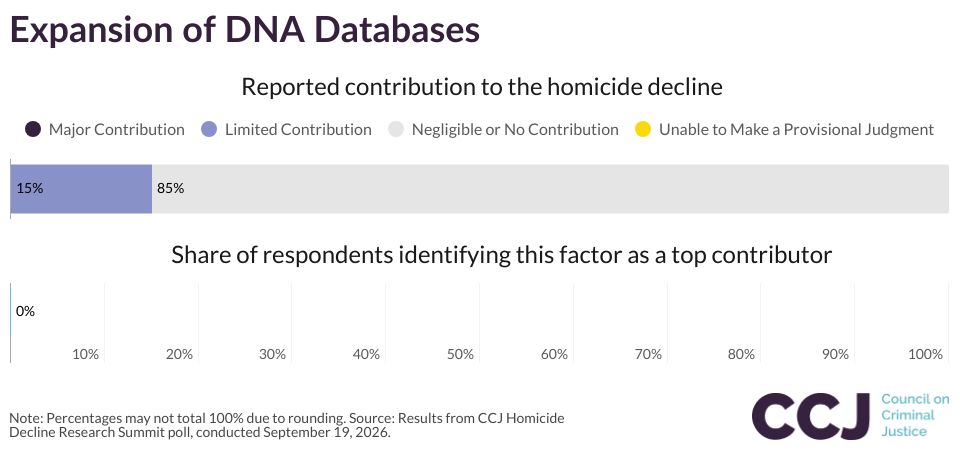
DNA databases allow police to compare crime-scene biological evidence with stored profiles and link evidence across crimes. The potential homicide connection is that broader searchable DNA coverage may generate investigative leads in serious crimes, support arrests that prevent repeat violence, and increase the perceived likelihood of detection. U.S. research exploiting changes in state DNA collection requirements found that database inclusion reduced the likelihood of a new conviction within five years by about 17% among people convicted of serious violent offenses, and that larger databases were associated with lower violent crime rates.93 Homicide-specific evidence is thinner and focuses mainly on investigations: A Cleveland study found no overall relationship between a DNA match and homicide clearance, although effects varied across case circumstances.94 Nationally, combined offender and arrestee profiles grew from about 19.4 million in October 2021 to 26.8 million in June 2026, a 38% increase, though some profiles belong to incarcerated people not at risk of community violence.95
The key questions are whether searchable DNA coverage expanded among people who were in the community and at risk of serious violence, and whether that growth increased detection or reduced repeat violence during the homicide decline.
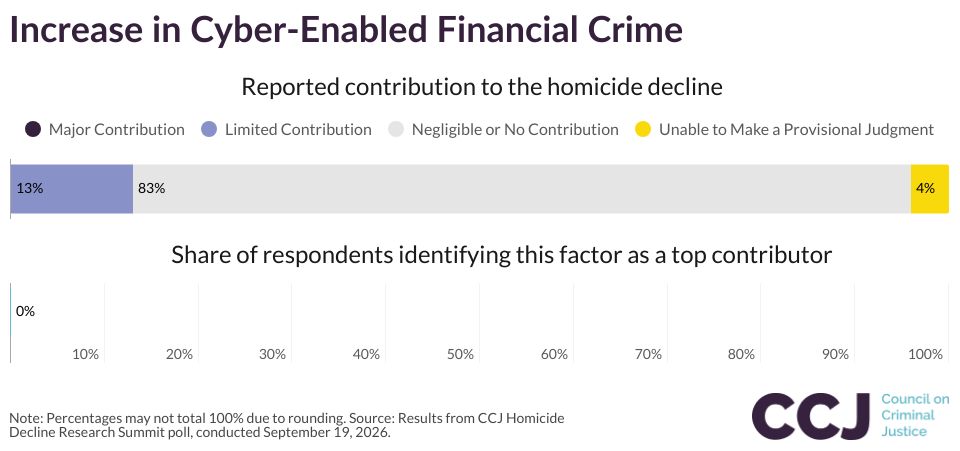
Cyber-enabled financial crime includes online fraud, identity theft, account takeover, and related crimes used to obtain money or financial information. The potential homicide connection involves substitution: If some financially motivated crime shifts from robbery or other in-person acquisitive crime to remote online activity, fewer in-person thefts and confrontations could mean fewer opportunities for serious violence. Research has not established that people engaged in traditional acquisitive crime routinely shift to cyber-enabled financial crime, and online and offline offending can overlap.96 Reported internet crime increased during the homicide decline: Complaints to the FBI rose from about 800,000 in 2022 to more than 1 million in 2025, while reported losses doubled from $10.3 billion to $20.9 billion.97 Some cyber-enabled financial crime affecting U.S. victims originates outside the U.S., although the exact share is unknown. The U.S. Department of the Treasury estimates that Americans lost at least $10 billion in 2024 to scam operations based in Southeast Asia alone, up 66% from the prior year.98
The key questions are whether growth in cyber-enabled financial crime coincided with a shift away from in-person acquisitive crime in the U.S., and whether any such shift reduced violent encounters that could otherwise have resulted in homicide.
Participant Comments
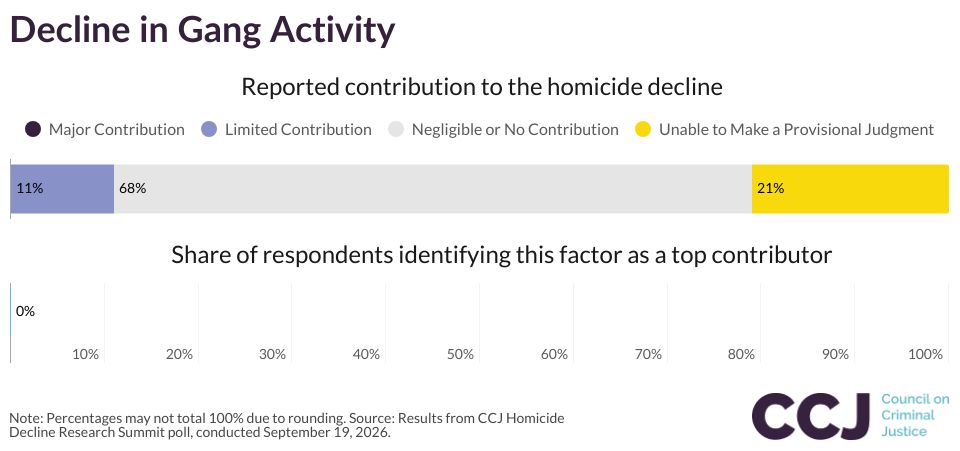
Gang activity is one context in which serious violence concentrates. The potential homicide connection is that gang involvement can increase exposure to violent conflict: Research links gang membership with higher rates of violent offending and victimization, while group conflicts can extend individual disputes through retaliation and firearm violence.99 Reviews of gang homicide similarly find that gang-related killings frequently involve firearms and occur in public settings.100 Older law-enforcement estimates suggest that gang-related homicides accounted for about 13% of U.S. homicides annually from 2007 to 2011 and 16% in 2012, with gang-related homicide more concentrated in large cities and accounting for larger shares of killings in some jurisdictions.101 Recent national trend evidence is limited: The last national law-enforcement estimates of gang membership and activity end in 2012, newer surveys measure lifetime rather than current gang membership, and changes in how agencies report detailed incident data complicate comparisons of more recent FBI gang-activity trends.102
The key questions are whether gang involvement declined, whether gang activity shifted away from violence, or whether both dynamics occurred in places experiencing the homicide decline.
Participant Comments
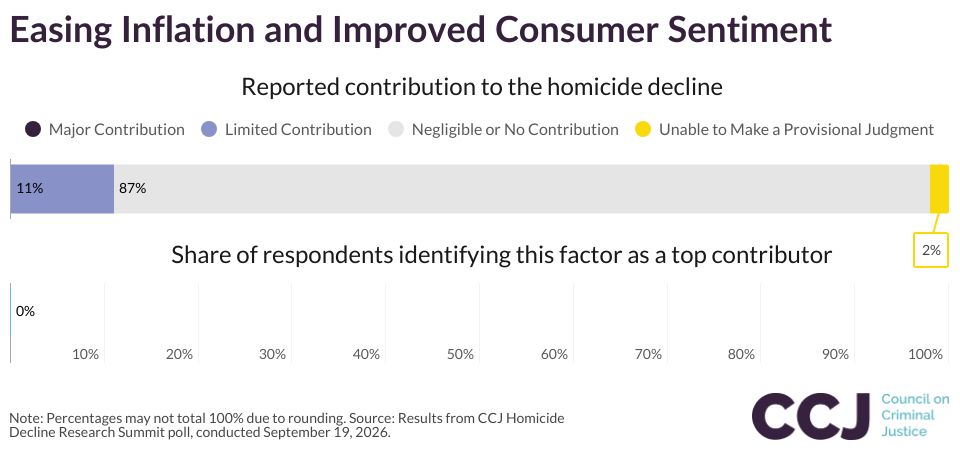
Inflation affects purchasing power, while consumer sentiment captures how people view their own finances and the broader economy. The potential homicide connection is that rising prices and worsening economic perceptions may increase financial strain and activity in informal or illicit markets where disputes can become violent. Research over several decades has linked both inflation and perceptions of economic conditions with homicide, although the relationship appears to operate partly through increases in acquisitive crime. Inflation has been associated with homicide, robbery, and burglary across U.S. and international data, and a study of 17 American cities found higher inflation associated with higher homicide rates, particularly in more disadvantaged cities.103 Earlier U.S. research found that worsening economic perceptions were associated with acquisitive crime and, indirectly, homicide, with a stronger relationship documented for felony-related killings than argument-related killings.104 Inflation fell from 9.1% in June 2022 to 3.0% a year later, while consumer sentiment rose from 50.0 in June 2022 to 79.0 in January 2024.105 Those trends later shifted: Inflation reversed course and rose in 2026, and sentiment fell below its June 2022 level for several months.
The key question is whether easing inflation and improving economic perceptions reduced the financial and illicit-market pressures linked to homicide as the decline began.
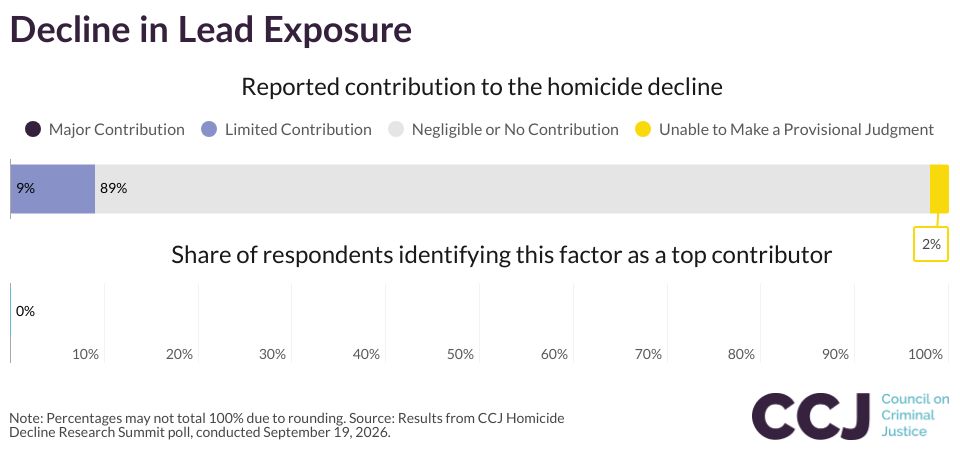
Childhood lead exposure has declined substantially in the U.S. over several decades. The potential homicide connection operates with a long lag: early lead exposure can affect brain development and is associated with later aggression, antisocial behavior, and serious violence. As generations of children with lower lead exposure reach adolescence and young adulthood—the ages when serious violence is more common—the population-level risk of homicide may decline. Research links childhood lead exposure with later delinquency and criminal behavior, including homicide and firearm violence.106 A 2022 meta-analysis of 24 studies found a positive relationship between lead exposure and crime and estimated that declining exposure could account for 7% to 28% of the long-run U.S. homicide decline, with estimates varying across studies.107 Blood lead levels among U.S. children under age five were 96% lower from 2017 to 2020 than in the late 1970s, although the largest reductions occurred decades ago and subsequent declines have been more gradual.108 Because the effects of childhood exposure may emerge years later, lead exposure would not need to decline sharply after 2022 to influence homicide during the recent period.
The key question is how much decades-long reductions in childhood lead exposure continued to affect homicide from 2022 to 2026 as lower-exposure generations reached ages of higher homicide risk.
Participant Comments
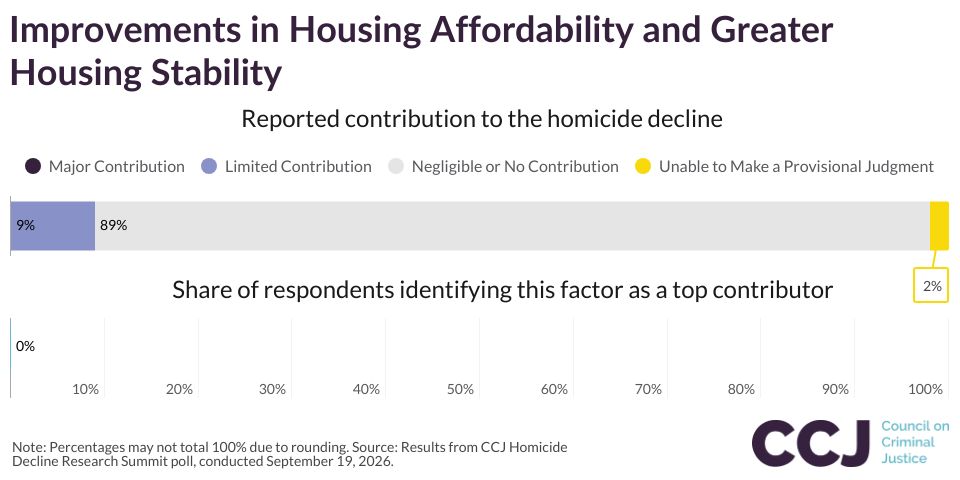
Housing affordability reflects housing costs relative to income; housing stability refers to remaining housed without repeated moves, eviction, displacement, or homelessness. The potential homicide connection is that improved affordability and greater housing stability may reduce financial hardship, displacement, and exposure to circumstances associated with violent offending and victimization. Housing loss can also lead to homelessness, where exposure to violence is high. Changes in housing costs may also change how much people work and whether they live alone, with family, or with roommates, potentially increasing or reducing time spent in settings where violence can occur; these pathways have been studied less directly. Across 126 cities, higher rent burden was associated with higher homicide rates, while eviction, vacancy, and other housing measures were not.109 Neighborhood studies found different patterns: Eviction was associated with homicide in Philadelphia, and declining affordability was associated with gun violence across four cities.110 Recent trends are mixed: Nearly half of renter households spent over 30% of their income on rent and utilities in 2024, eviction filings in tracked locations dipped in 2025, and homelessness remained about 28% above 2022 levels despite falling from 2024 to 2025.111
The key question is whether improvements in housing affordability or stability were followed by reductions in serious violence, particularly in places experiencing homicide declines.
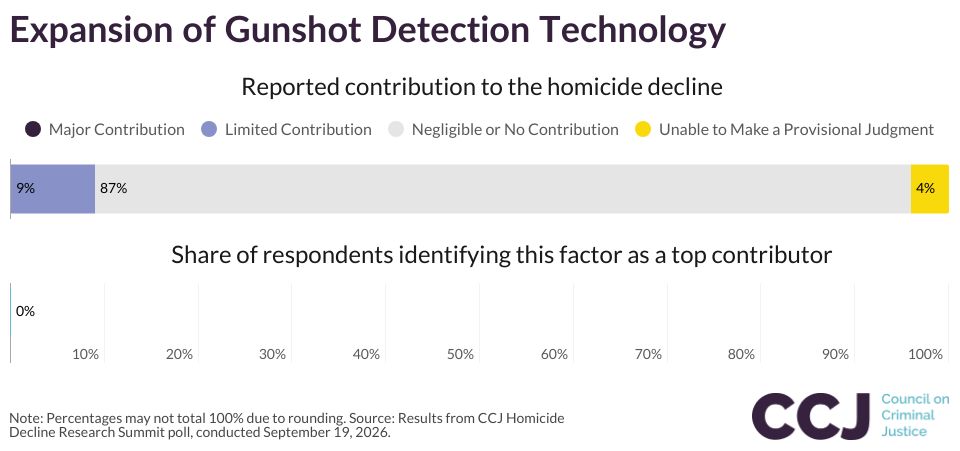
Gunshot detection technology uses acoustic sensors to identify outdoor gunfire and alert police to the approximate location of shots fired. The potential homicide connection is that gunshot alerts may support investigations and apprehension after shootings or shorten the time between a shooting and emergency care, potentially affecting both shooting incidence and lethality. Studies examining response and trauma outcomes have found shorter response or prehospital times following gunshot detection alerts, but have not found lower mortality among shooting victims.112 Across studies of crime and investigative outcomes, findings are mixed: A 2026 meta-analysis found no overall relationship between gunshot detection and crime, while a Detroit evaluation found lower violent crime but no change in case clearance after deployment.113 Deployment patterns were mixed during the homicide decline: ShotSpotter’s parent company, SoundThinking, reported contracts in more cities in 2025 than in 2022, while some jurisdictions, including Chicago, discontinued use.114
The key questions are whether changes in gunshot detection use from 2022 to 2026 improved shooting investigations, shortened the time to emergency care, or both—and whether those changes corresponded with fewer shootings or deaths.
Participant Comments
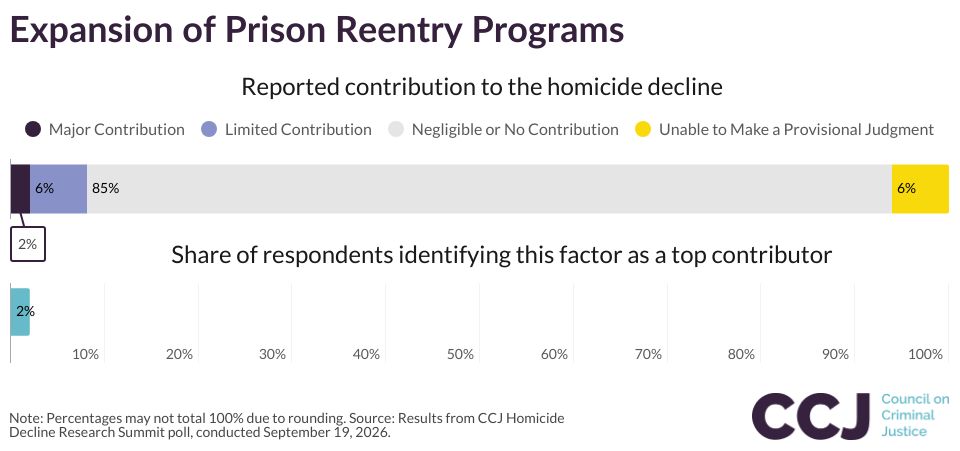
Prison reentry programs include services delivered before or after release, such as housing and employment assistance, behavioral health and substance use treatment, mentoring, and case management. The potential homicide connection depends on the services provided: Housing, employment, mentoring, and family supports may reduce instability after release, while behavioral health and substance use treatment may address problems associated with later offending. Evidence specific to homicide or violent reoffending is limited. Across evaluations, effects on general recidivism are mixed; randomized evaluations of broad service packages have often found little or no effect, while some multisite programs have been associated with fewer arrests over longer follow-up.115 During the pandemic, many reentry programs were forced to reduce access or suspend in-person services, and some federally funded programs were still recovering into 2023; as restrictions eased, access may have increased through both the resumption of existing services and the addition of new programming, although there is no national measure of either change.116 Reentry effects may unfold over several years, therefore programming received before 2022 could also have influenced offending during the decline.
The key questions are whether reentry services resumed or expanded in the years before and during the homicide decline, particularly for people at elevated risk of serious violence, and whether those changes affected later offending.
Participant Comments
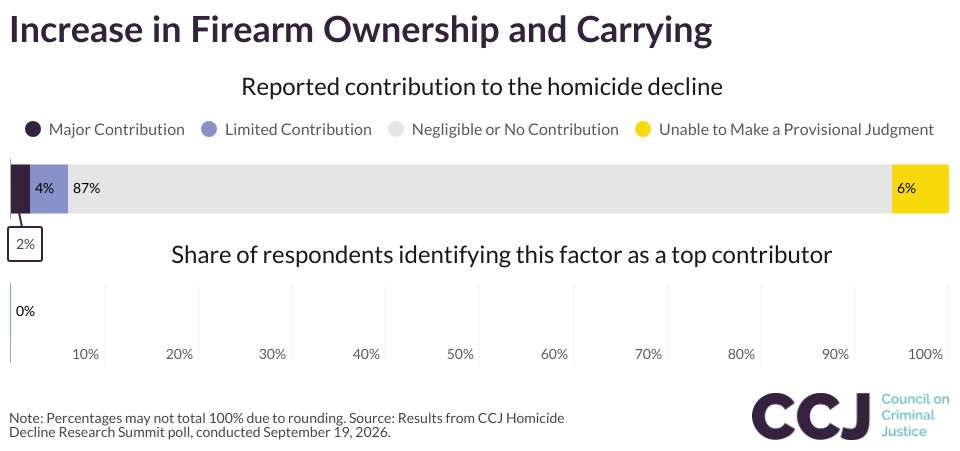
Firearm ownership and carrying refer to civilians owning guns and carrying them in public. The potential homicide connection may operate through competing pathways: More armed civilians could deter or interrupt violence, while greater firearm availability can make violent encounters more lethal and increase the number of guns available through theft. Firearm ownership among U.S. adults rose from 25% in 2019 to 30% in 2024.117 Legal concealed carrying also expanded as states changed their carry laws, although national data do not show how often people actually carried guns.118 Prior research has linked higher firearm ownership and more permissive carry laws with higher rates of firearm homicide or other gun violence.119 The recent homicide decline was concentrated in firearm homicide: From 2021 to 2025, firearm homicides fell 40%, compared with 20% for homicides involving other weapons; firearm homicides accounted for 86% of the overall decline.120 Those reductions occurred while gun ownership remained above pre-pandemic levels and legal carrying continued to expand.
The key question is whether increased ownership and carrying changed firearm access, defensive use, or the lethality of violent encounters among the people, networks, and places where firearm homicide was concentrated during the period when gun homicides fell sharply.
Participant Comments
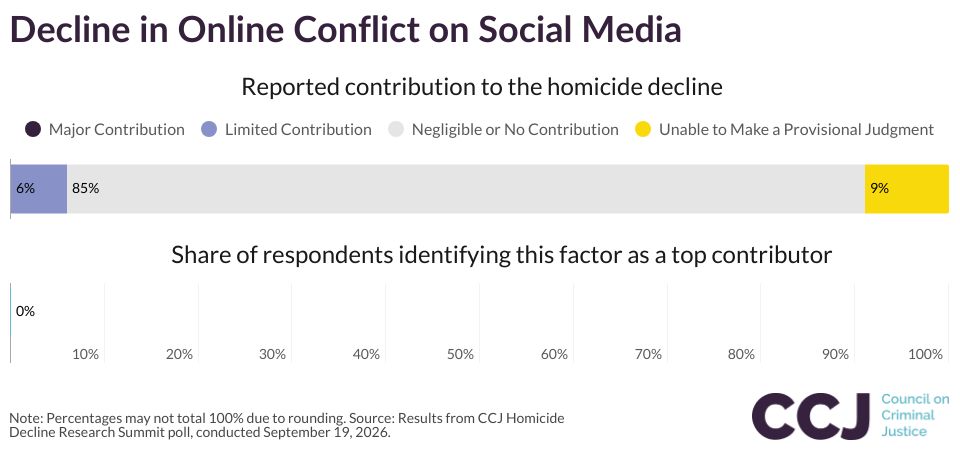
Online conflict on social media includes disputes, threats, insults, and challenges to someone’s reputation or standing that unfold in front of an online audience and may extend into offline interactions. The potential homicide connection is that these exchanges can expand the audience for disputes, provide information about potential targets, and provide information that can be used to coordinate confrontations. Research on gangs and homicide identifies escalation, targeting, and information gathering as ways social media can become part of serious violence, but homicide-specific evidence remains limited.121 U.S. studies do not show a consistent progression from online conflict to offline violence. In Chicago, for example, shootings predicted later hostile online comments, while hostile comments did not predict later shootings; other research found that gang-affiliated posts containing threats or hostile language, or expressing anger or sadness after a death or incarceration, were associated with next-day violent crime.122 In Prince George’s County, Maryland, 2% of 22,801 violent crimes from 2018 to 2023 had a documented social-media connection.123 There is no national measure showing whether violence-related online conflict increased or decreased during the homicide decline.
The key question is whether online conflicts tied to serious violence became less common or less likely to become in-person violence during the decline.
Participant Comments
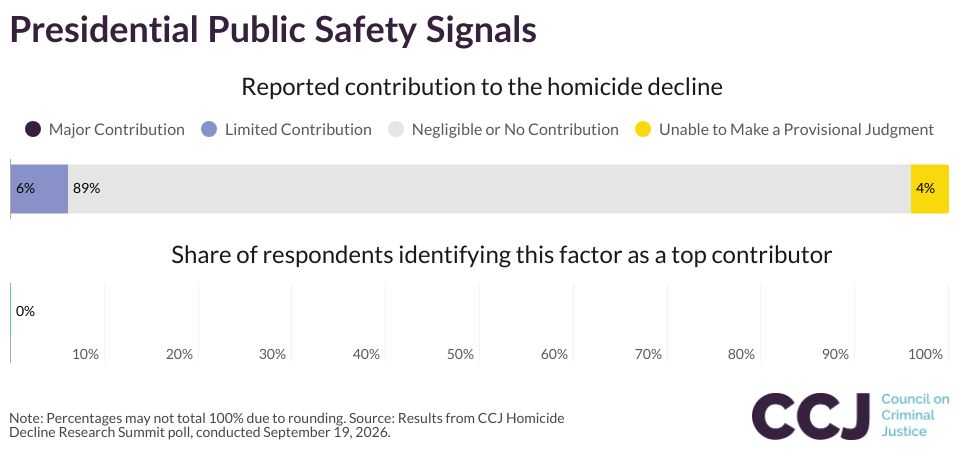
Presidents can send public signals about crime and public safety through rhetoric, public statements, and the way they frame personnel choices and enforcement priorities, and the impact of such signals can be distinct from the direct effects of presidential choices and policies. The potential homicide connection is that these signals could change how likely people believe they are to be caught or punished, potentially deterring violence; they may also influence the behavior of police and prosecutors or affect public trust and cooperation with law enforcement. Research suggests that national political signals can affect behavior, including some forms of violent hate crime, but there is little direct evidence connecting presidential messaging or leadership to homicide trends generally.124 Long-run national research also finds little evidence that violent crime rates systematically differ by presidential party.125 The national homicide decline began under President Joe Biden and continued after President Donald Trump returned to office in 2025, so any presidential-signaling effect would need to be tied to specific shifts in messaging or expectations, rather than to political party or officeholding alone.
The key question is whether shifts in presidential public-safety signaling from 2022 to 2026 changed expectations or behavior related to serious violence in ways that may have shaped the homicide decline.
Participant Comments
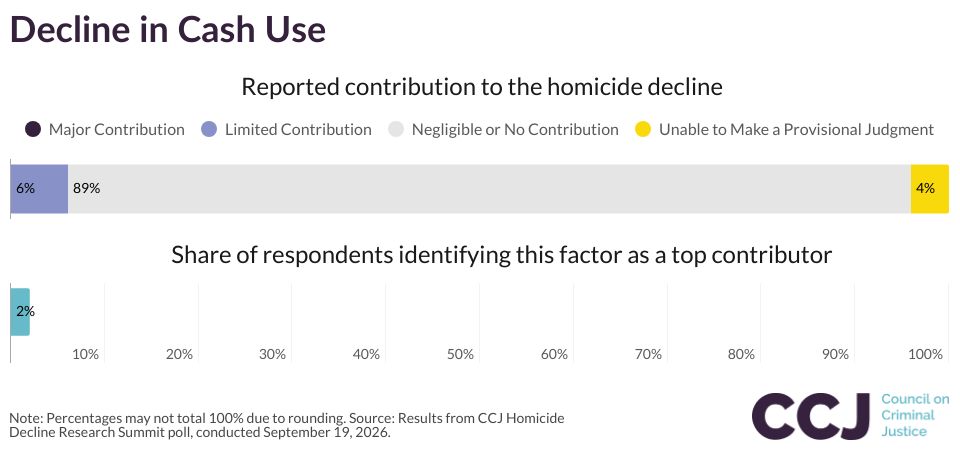
The shift from cash to digital payments may affect crime by reducing the amount of money available to steal in face-to-face encounters. The potential homicide connection is indirect: Carrying and exchanging less cash may reduce robberies, thefts, or cash-based illicit-market transactions that can create opportunities for confrontations to become violent. Evidence for this pathway is limited but consistent with the basic premise. When electronic benefit transfer (EBT) cards replaced checks and cash for public benefits, overall crime fell by 9.2%, with declines of over 10% in burglary, assault, and larceny; the estimated effect on robbery was also negative but was not statistically significant.126 Cash use has continued to fall as a share of consumer payments, from 18% in 2022 to 14% in 2024, although the average number of monthly cash payments has remained unchanged since 2020, and cash carried by consumers remains above pre-pandemic levels.127
The key question is whether reduced cash use from 2022 to 2026 changed the frequency of robbery or other cash-related encounters in ways that contributed to the homicide decline.
Participant Comments
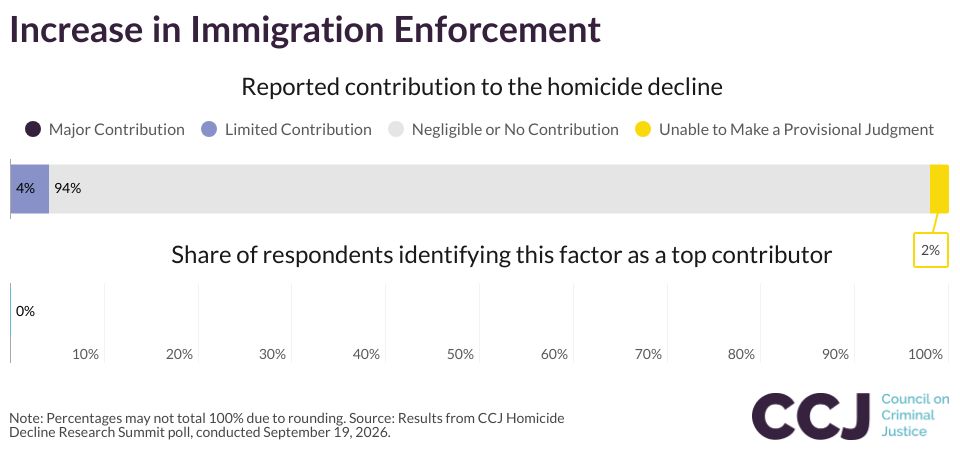
Immigration enforcement includes efforts at the borders and within the U.S. to identify, arrest, detain, and deport noncitizens who may be subject to removal. The potential homicide connection is that enforcement could prevent entry by people who might commit serious violence, deter offending, or detain or deport people who might otherwise commit serious violence. Prior evaluations have generally found little effect on serious violence. Two studies of Secure Communities, a nationwide program linking local arrests with federal immigration enforcement, found no observable effect on violent crime or homicide; a study of 287(g) agreements in North Carolina likewise found no reduction in murder or other violent crime.128 Federal immigration enforcement expanded sharply beginning in January 2025; over the following year, ICE arrests quadrupled and average daily detention numbers nearly doubled.129 That expansion began well after homicide began falling in 2022. The increase in arrests was concentrated among people with no prior convictions or nonviolent convictions, while arrests of people with prior violent convictions changed much less.130
The key questions are whether serious violence changed after the 2025 enforcement surge among the people and places most affected by it, and whether any such change can be separated from the homicide decline that was already underway.
Participant Comments
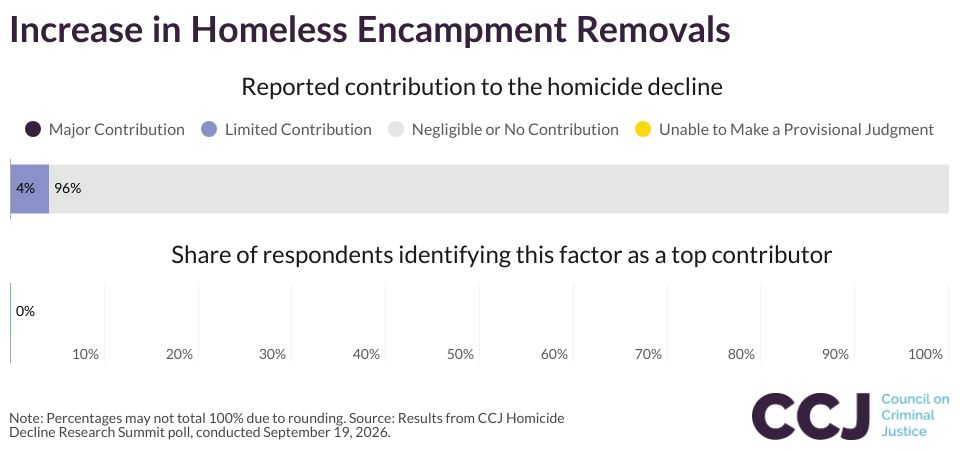
Homeless encampments were becoming more common before COVID-19 and became more visible in cities during the pandemic. As cities emerged from the pandemic, removals became more frequent; in 2024, the Supreme Court held that enforcing public-camping laws does not violate the Eighth Amendment.131 The potential homicide connection is whether encampments concentrate serious violence in particular places; removing them could reduce those concentrations, leave them unchanged, or shift violence elsewhere. A 2024 review links homelessness with both offending and victimization, emphasizing the adversity and exposure that accompany homelessness rather than homelessness itself.132 A study using data from Boulder, Colorado, found that crime concentrated near encampments but could not establish causation or who was involved, while a Canadian study found that most encampments were not followed by increases in violent crime in the surrounding area; where violent crime changed significantly, decreases were more common than increases.133 Studies of encampment removal found no consistent reduction in violence: A Bronx encampment closure produced no short-term change in nearby crime, while Denver removals produced localized declines in disorder and auto theft but not in violent crimes.134
The key question is whether increased encampment removals reduced serious violence or shifted where it occurred during the homicide decline.
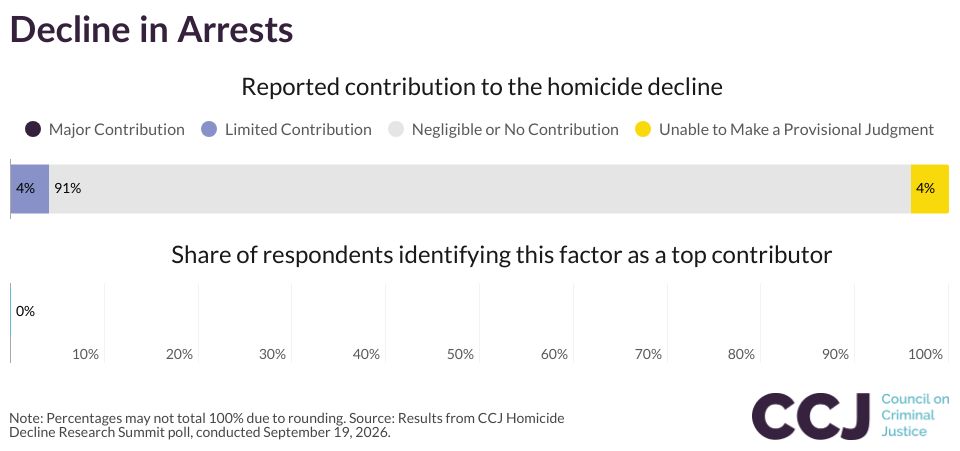
Arrests fell sharply during the pandemic and remained below pre-pandemic levels in 2024, reducing the number of people exposed to formal criminal justice contact. The potential homicide connection may operate through competing pathways: Fewer arrests may reduce deterrence or incapacitation, while less arrest exposure for lower-level offending may reduce disruptions—to school, work, family, and peer relationships—that are associated with later offending. Evidence for the latter pathway is strongest among youth: A meta-analysis of controlled trials found that formal juvenile system processing did not reduce later delinquency and may increase it, while longitudinal research links police stops and arrests with higher subsequent delinquency.135 At the same time, research on 53 large U.S. cities from 2010 to 2015 found no evidence that declining arrest rates caused the 2015 increase in homicide.136 Recent trends are mixed: Total arrests in 2024 remained 25% below 2019 levels, but juvenile arrest rates have risen since 2020.137
The key questions are which arrests declined, among whom, and whether those changes reduced later serious violence or instead reduced enforcement against people at elevated risk of committing it.
Participant Comments
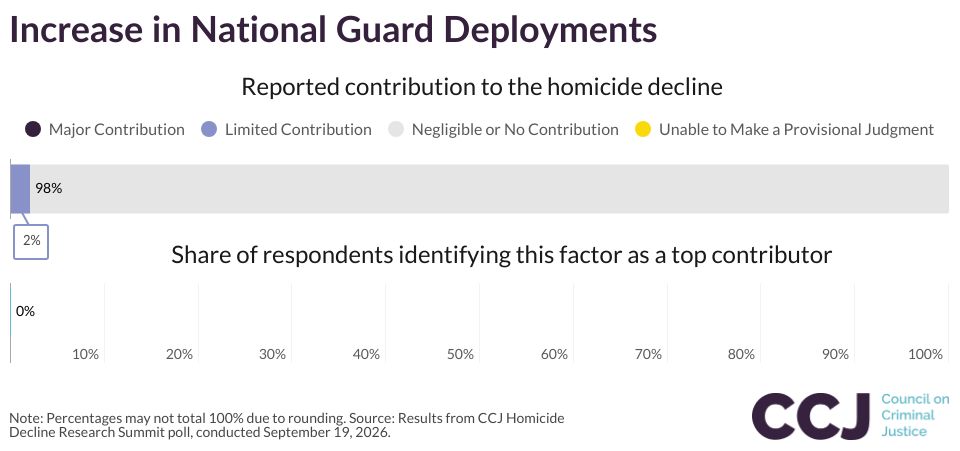
Beginning in summer 2025, the Trump administration deployed or sought to deploy National Guard personnel in several major U.S. cities, with missions spanning public safety, immigration enforcement, and protest response. The potential homicide connection is that deployments could reduce violence in targeted cities by increasing enforcement, deterring violence, adding capacity, or freeing local police to focus on serious violence. The prospect of deployment elsewhere could also extend deterrence beyond those cities. Deployments varied in size, duration, purpose, and location, and information on where personnel were stationed and what they did is incomplete. In Washington, D.C., 2,000 guard personnel were deployed, largely in commercial, transit, and tourist areas; a study found reductions in opportunistic property crime but not violent crime.138 A multi-city analysis found no statistically significant reduction in weekly homicide rates after deployments in Los Angeles, Memphis, and Washington, D.C.139 Memphis saw an initial but unsustained decline in violent crime.
The key question is whether deployments affected serious violence, either in cities where they occurred or elsewhere through the prospect of deployment, and if so, whether those effects changed the pace of the national homicide decline after 2025.
Participant Comments
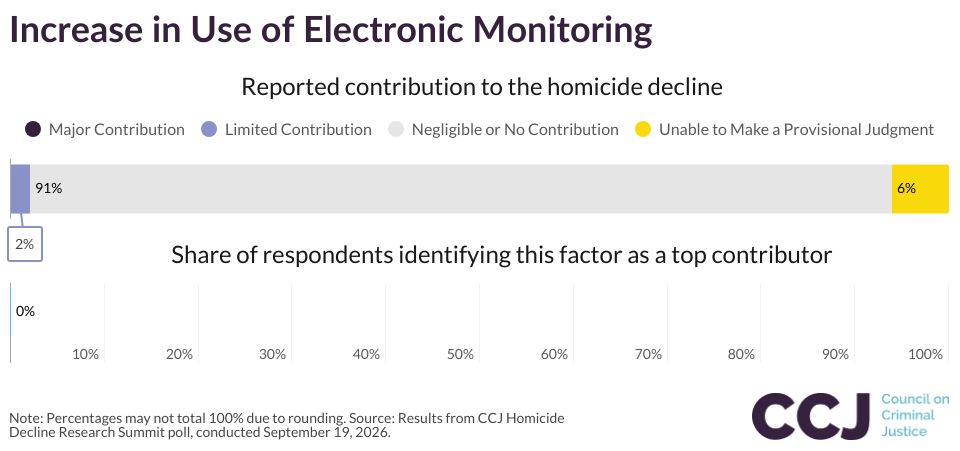
Electronic monitoring uses GPS, radio-frequency devices, smartphone applications, and related technologies to track people in community settings, often during pretrial release, probation, parole, or home confinement. The potential connection to homicide depends in part on what electronic monitoring is used to do and what it replaces: Monitoring may deter prohibited movement or contact, help authorities respond to violations, and provide location information for investigations. But when it replaces incarceration, people who otherwise would have been confined remain in the community. Evidence on serious reoffending is mixed and rarely examines homicide specifically. Across U.S. evaluations, electronic monitoring has not consistently reduced serious new charges or rearrest for violent crimes; one California program found lower violent rearrest among people on parole receiving GPS monitoring and intensive supervision, but the effects of monitoring could not be separated from the additional supervision.140 The estimated number of people electronically monitored through the criminal justice system rose from about 53,000 in 2005 to 150,700 in 2021; the 2021 number is equivalent to about 4% of the probation and parole population that year, although the estimate also included people in pretrial and other statuses.141
The key questions are whether electronic monitoring expanded or was used differently from 2022 to 2026, and whether those changes affected serious violence through greater detection and intervention, substitution for incarceration, or both.
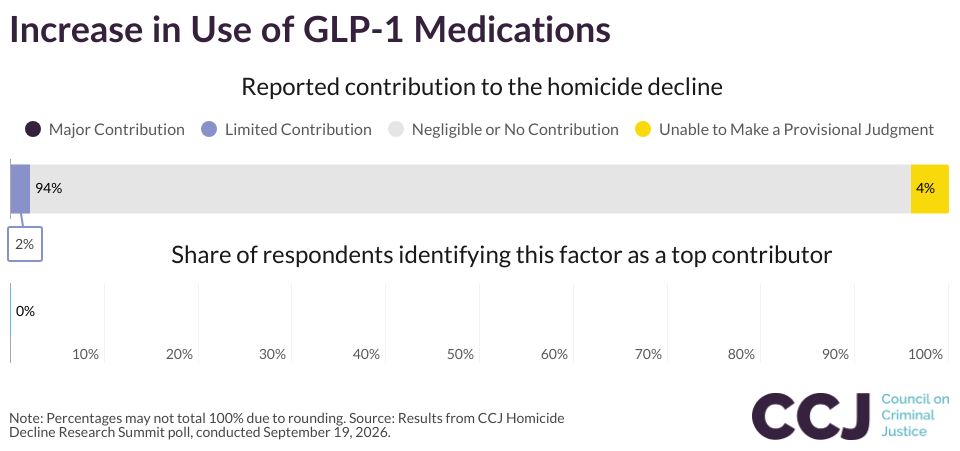
Glucagon-like peptide-1 receptor agonists, commonly known as GLP-1s, are medications used to treat Type 2 diabetes and, for some medications, obesity or weight management. The potential homicide connection is indirect: If GLP-1s reduce impulsivity, craving, heavy substance use, or related behaviors, they may reduce the likelihood that conflicts or crises become violent. Evidence linking GLP-1s to violence is limited and not homicide-specific. A 2022 animal study found that activating GLP-1 receptors reduced the development of aggression-like behavior in male mice.142 A national survey of U.S. adults who had used GLP-1 medications found that current users showed weaker associations between impulsivity and self-reported violent behavior, and between alcohol use and self-reported violent behavior, than former users.143 The impulsivity finding was more consistent than the alcohol finding, and the analytic sample was 63% female and concentrated among adults ages 35 and older, making its relevance to populations at elevated risk of serious violence less clear.
The key question is whether GLP-1 use became common enough among populations at elevated risk of serious violence, early enough in the decline, for those behavioral effects to register in homicide trends.
Participant Comments
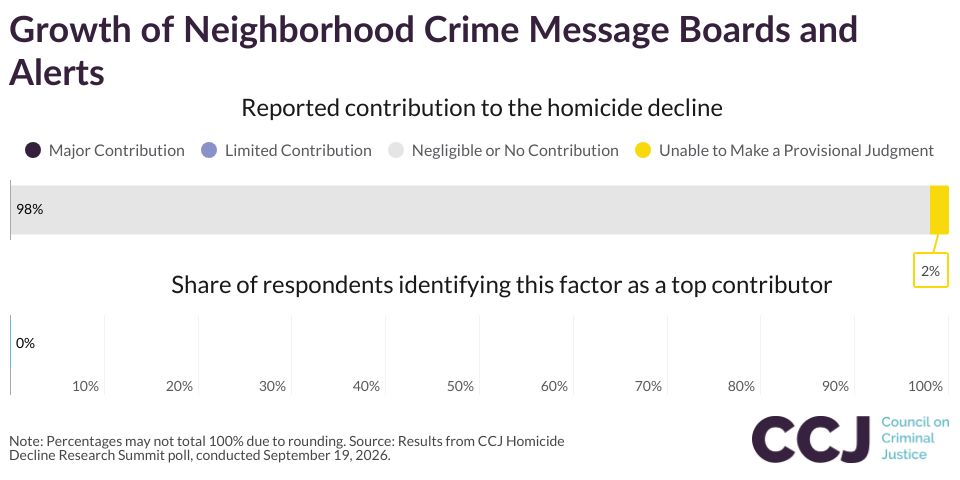
Neighborhood crime message boards and alerts are place-based online platforms where residents exchange information about crime, suspicious activity, and safety concerns. The potential homicide connection is that local alerts may change where people go, how watchful they are, and whether they share information, video, or witness accounts with neighbors or police, potentially changing opportunities for violent offending and victimization or providing information after serious incidents. U.S. research suggests these platforms can change how residents perceive and respond to crime, but has not established effects on crime itself. A Denver study of Nextdoor posts found residents warning neighbors, seeking information or security footage, and discussing surveillance and other precautions, while national studies found neighborhood-app use associated with higher perceptions of local crime and greater crime concern.144 Nextdoor reached one-third of U.S. households in 2025, but available data do not show whether crime-related use increased during the homicide decline.145
The key question is whether use of these platforms changed residents’ routines, vigilance, reporting, or evidence-sharing in ways associated with serious violence or its investigation during the homicide decline.
Participant Comments
Priorities for Future Research
CCJ asked summit participants what research questions, data, or analyses would most improve understanding of what drove the homicide decline between 2022 and 2026. Respondents were invited to provide open-ended responses detailing one or more research priorities.
Table 1 summarizes the areas they identified.146 Community violence intervention and descriptive and comparative analyses were the two most frequently mentioned areas, with 13 mentions each, followed by gun policy and carrying and the examination of long-term trends, each of which received 10 mentions. Drugs, incapacitation, retaliatory violence, and the future of violence prevention each received one mention.
Across the comments, participants frequently called for research that examines how multiple social and policy factors may operate at the same time or interact, rather than exploring a single explanation for the homicide decline. They also emphasized the importance of studying the trends that preceded the decline, particularly the rise in homicide from 2015 to 2021.
Table 1: Areas for Further Homicide Research
Community Violence Intervention and Related Programs
Approaches involving community collaboration, including CVI, focused deterrence, hospital-based violence intervention, and related approaches, were among the most frequently mentioned research priorities.
Respondents noted rapid changes to these programs at the onset of the COVID-19 pandemic and in subsequent years, but emphasized that the evidence base has not kept pace with their adoption. Multiple participants proposed a national inventory documenting where programs operate, their characteristics and funding, and measures of implementation, dosage, and fidelity.
They also recommended using variation in when and where programs were deployed to conduct quasi-experimental evaluations. Studies could compare jurisdictions that received earlier or more intensive interventions with otherwise similar jurisdictions that received less intervention, while accounting for pretreatment trends, regression to the mean, and displacement. In addition, participants called for mixed-methods and qualitative research, including studies of how police and non-law enforcement providers work together as part of a broader violence-reduction strategy.
Comparative Research Across Places and Time
One of the most frequently mentioned priorities was a more detailed description of how homicide changed from 2022 to 2026, including how different places and populations returned toward the long-term trend that emerged in the 1990s before being interrupted in 2015. Researchers said emphasis should be placed on determining whether the same cities, neighborhoods, demographic and age groups, and types of homicide that drove the increase also drove the decline.
Participants recommended comparisons across multiple levels of analysis, including countries, states, cities, and neighborhoods. Cross-national comparisons could help identify broad social patterns, while more local analyses could examine factors specific to particular places. Several summit scholars proposed case studies to compare cities that experienced large homicide declines with those that did not and examine differences between them.
Gun Policy and Gun Carrying
Firearms emerged as one of the most frequently mentioned areas in need of further research. Participants noted that the recent decline was concentrated heavily in firearm homicides, and that researchers lack good measures of firearm access and carrying, particularly among people at greatest risk of homicide involvement. Several respondents requested better individual- and local-level measures of legal and illegal carrying.
Specific data needs included detailed crime-gun trace data, information about the original purchaser and possessor of guns involved in crimes, time-to-crime measures, firearm trafficking networks, and ghost guns. Respondents also proposed examining whether certain firearms affected by specific laws appear less frequently in homicide incidents and whether firearm restrictions changed gun availability among high-risk individuals. They also suggested state-level analyses comparing changes in homicide across states with varying degrees of gun restrictions.
Long-Term Homicide Trends
Throughout the summit, participants raised a broader question: Is the recent historic low in homicide a continuation of the decline that began in the 1990s, or does it represent a new trend? Examining the recent decline in a longer historical context could help researchers identify social changes that develop over years, or decades.
Respondents recommended city-level analyses extending back to at least the early 1990s. Such studies could uncover whether the increase in homicide that occurred in 2020 and 2021 was a temporary departure from a longer-term decline and whether the post-2022 decline represents a return to that trajectory or a new structural change.
Long-term analyses could also incorporate international comparisons and key macro-level correlates of crime. Participants suggested examining lagged effects of broader social changes or policy interventions and the possibility of a “tipping point,” in which homicide falls below a certain threshold and subsequent declines become self-reinforcing.
Differences Across Populations and Types of Homicide
Participants cautioned against treating homicide as a single phenomenon. Future studies could distinguish among community violence, intimate partner homicide, homicides involving women and children, gang-related violence, and other circumstances. If different types of homicide followed different trajectories, the factors contributing to those changes might differ as well.
There was also substantial interest in the “tail” of the homicide distribution: the relatively small population of people at greatest risk of homicide involvement. Researchers could examine whether the decline occurred because this high-risk population became smaller, because people within the high-risk group became less likely to commit homicide or be victimized, or both. This work may require linking mortality, criminal justice, demographic, and individual-level data.
Several respondents called for research on racial, ethnic, and socioeconomic differences in the decline, including whether trends differed across Black, Hispanic, and White communities and whether and how socioeconomic conditions shaped those patterns. Ethnographic research could provide information on changes in attitudes, behavior, police interactions, informal social control, and violence within communities that administrative data cannot capture.
Government Capacity
Summit attendees called for more research on the ability of federal, state, and local governments to address homicide through policing, CVI, and other public safety and social programs. Rather than treating government capacity as a single strategy, respondents suggested examining how combinations or “bundles” of government programs and investments may affect violence. Several also called for closer study of the role American Rescue Plan Act funding may have played in reducing homicide.
Policing
Policing was mentioned less often than CVI as a research priority. Participants called for further study of targeted policing strategies during the decline period and changes in police staffing levels, and for clearer definitions of “proactive” policing strategies. Improvements in homicide clearance rates and the expansion and effectiveness of police technologies were also identified as areas for further research.
Other Areas for Exploration
Summit participants raised several additional topics throughout the meeting and in their poll responses:
- Whether Homicide has Reached a “New Normal”: Some participants raised the possibility that the events of 2020, particularly the COVID-19 pandemic, produced broader social changes that are not yet well understood. Suggested areas for study included changes in alcohol use, time spent at home rather than in public places, and youth mental health issues that may be crime-inhibiting, such as depression.
- Excess Mortality and Violence: Respondents called for better and more complete data on excess deaths and a clearer profile of people at greatest risk of violence from 2020 to 2022.
- Facial Recognition: Participants identified a need for better data on the timing and use of facial recognition technology and for comparisons between agencies that use it and those that do not.
- Drugs: Suggested areas of analysis included the potential impact of individual drug use patterns, including a possible substitution of cannabis for alcohol, and changes in street drug markets.
- Incapacitation: Participants called for network analyses examining how incarceration may have changed risks of committing violence or being victimized.
- Retaliatory Violence: Respondents suggested research estimating how much of the homicide rise and decline may be related to changes in retaliatory violence.
Conclusion
After reaching a peak in the early 1990s, crime in the United States fell steadily through the remainder of the decade and into the 2000s. At the time, policymakers, pundits, and the public assigned credit and blame to a wide range of factors, from the waning crack cocaine epidemic to a wave of police hiring. More than three decades later, researchers still debate what drove that decline, though there is broad agreement that multiple forces were at work.
The historic drop in homicide from 2022 to 2026 has sparked similar interest in explaining what happened, particularly given the spike that preceded it in 2020 and 2021. Elected leaders and the media are understandably eager to identify cause and effect, while researchers typically call for more analyses and better data. In the meantime, competing explanations can make it difficult for policymakers and the public to distinguish between factors that may have contributed to the decline and those that have little evidence behind them—and to decide where additional research and public safety resources may be most useful.
CCJ’s Homicide Decline Research Summit put the nation’s top scholars to work on this challenge in real time, reflecting the historic nature of the recent trend and the shared sense of urgency to understand a phenomenon with real human costs. Distinguishing between individual explanations is inherently difficult, because policies, social conditions, and other dynamics often overlap and shift at the same time. Summit participants emphasized that several influential factors may have operated together or reinforced one another. That said, their work focused attention on a short list of the most plausible contributors, identified explanations that have little support, and highlighted areas where judgment remains divided. The scholars also produced a priority list of research and data with the most promise to improve understanding of what drove the homicide decline.
The summit was not convened to provide definitive conclusions about the past four years or produce a concrete roadmap for reducing criminal homicide in the future. Instead, it brought the best available evidence and the professional judgment of top researchers to bear on a rapidly evolving debate, narrowing some questions while identifying others that remain unresolved.
Acknowledgements
This report was produced by Stephanie Kennedy, Ernesto Lopez, and Abby Walsh, with quality control review by Olivia McLarnan.
Amy Solomon facilitated the Homicide Decline Research Summit. The event was managed by Hannah Bolotin with support from Zelle Calina.
Shawn Bushway, Aaron Chalfin, Brandon del Pozo, James Densley, Beau Kilmer, Michael Light, John MacDonald, Greg Midgette, Andrew Morral, Andy Papachristos, Jillian Peterson, Alex Piquero, Eric Piza, John Roman, Rosanna Smart, James Tuttle, and Daniel Webster contributed research briefs on various topics. Aaron Chalfin, Charis Kubrin, Alex Piquero, and Garen Wintemute served on the project’s advisory group.
Support for the Homicide Decline Research Summit comes from Fund for a Safer Future, Arnold Ventures, The Harry Frank Guggenheim Foundation, The Health Alliance for Violence Intervention, The Joyce Foundation, The John D. and Catherine T. MacArthur Foundation, and the Public Welfare Foundation. CCJ also receives support from The Just Trust, Georgia Power Foundation, and other general operating contributors. In kind support was provided by Arizona State University’s School of Criminology and Criminal Justice.
Suggested Citation
Council on Criminal Justice. (2026). What’s driving the homicide decline? An assessment by leading researchers. https://counciloncj.org/whats-driving-the-homicide-decline
Endnotes
1 Centers for Disease Control and Prevention. (2024). Youth violence prevention: About youth violence. https://www.cdc.gov/youth-violence/about/index.html
2 Niknam, B. A., Desjardins, M. R., Stuart, E. A., Richardson, J., & Webster, D. W. (2026). Effects of two
community violence interruption programs on firearm violence in Washington, DC. American Journal of Epidemiology, 195, 1974–1983. https://academic.oup.com/aje/article/195/7/1974/8454589; Pyrooz, D.
C., Sanchez, J. A., & Weltman, E. (2025). Multidisciplinary teams, street outreach, and gang intervention: Mixed methods findings from a randomized controlled trial in Denver. Criminology, 63, 575–613. https://doi.org/10.1111/1745-9125.70002; Tilchin, C., Wagner, E. D., Doucette, M. L., Niknam, B. A.,
Buggs, S. A., Desjardins, M. R., & Webster, D. W. (2026). Impacts of Safe Streets, a community violence
intervention, on youth violence in Baltimore City. Injury Prevention. https://doi.org/10.1136/ip-2025-045716
3 Love, H., Barr, A., & Odumosu, O. (2022). Addressing the root causes of gun violence with American Rescue
Plan funds: Lessons from state and local governments. Brookings. https://www.brookings.edu/essay/addressing-the-root-causes-of-gun-violence-with-american-rescue-plan-funds-lessons-from-state-and-local-governments/
4 Kegler, S. R., Simon, T. R., Zwald, M. L., Chen, M. S., Mercy, J. A., Jones, C. M., … & Dills, J. (2022). Vital signs: Changes in firearm homicide and suicide rates—United States, 2019–2020. Morbidity and Mortality Weekly Report, 71(19), 656–663. https://doi.org/10.15585/mmwr.mm7119e1
6 Hoeboer, C. M., Kitselaar, W. M., Henrich, J. F., Miedzobrodzka, E. J., Wohlstetter, B., Giebels, E., … & de Kogel, C. H. (2024). The impact of COVID-19 on crime: A systematic review. American Journal of Criminal Justice, 49, 274–303. https://doi.org/10.1007/s12103-023-09746-4; Meyer, M., Hassafy, A., Lewis, G., Shrestha, P., Haviland, A. M., & Nagin, D. S. (2022). Changes in crime rates during the COVID-19 pandemic. Statistics & Public Policy, 9(1), 97–109. https://doi.org/10.1080/2330443X.2022.2071369
7 National Center for Education Statistics. (n.d.). Shifts in enrollment and instructional mode. https://nces.ed.gov/surveys/annualreports/topical-studies/covid/theme/elementary-and-secondary-education-shifts-in-enrollment-and-instructional-mode/; U.S. Bureau of Labor Statistics. (2022). The
employment situation-April 2022. https://www.bls.gov/news.release/archives/empsit_05062022.htm;
Zviedrite, N., Jahan, F., Moreland, S., Ahmed, F., & Uzicanin, A. (2024). COVID-19-related school closures, United States, July 27, 2020-June 30, 2022. Emerging Infectious Diseases, 30(1). https://wwwnc.cdc.gov/eid/article/30/1/23-1215_article
9 Kapustin, M., Chalfin, A., Biddle, J., Wade, B. A., Khade, N., Layana, C., … & Braga, A. A. (2026). Reducing
gun violence at scale (Working Paper No. 35292). National Bureau of Economic Research. https://papers.ssrn.com/sol3/papers.cfm?abstract_id=6897281; Moyer, R. A. (2025). Assessing the effects of the Group Violence Intervention on firearm violence in Philadelphia. Journal of Experimental Criminology, 21, 527–557. https://doi.org/10.1007/s11292-023-09601-w
11 U.S. Department of the Treasury. (n.d.). State and Local Fiscal Recovery Funds. https://home.treasury.gov/policy-issues/coronavirus/assistance-for-state-local-and-tribal-governments/state-and-local-fiscal-recovery-funds
13 Bushway, S. D., Robey, J., & Humphreys, K. (2026). Running out of inmates? Cohort non-replacement
and the approaching end of mass incarceration. Annual Review of Criminology. https://doi.org/10.1146/annurev-criminol-022222-034050; Federal Bureau of Investigation. (2020). Table 29: Estimated number of arrests, United States, 2019. Crime in the United States. https://ucr.fbi.gov/crime-in-the-u.s/2019/crime-in-the-u.s.-2019/topic-pages/tables/table-29; Federal Bureau of Investigation. (2026). Table 29: Estimated number of arrests, United States, 2025. Crime Data Explorer. https://cde.ucr.cjis.gov/LATEST/webapp/#/pages/home
14 Bushway, S. D., & Uggen, C. (2021). Fostering desistance. Contexts, 20(4), 34–39. https://doi.org/10.1177/15365042211058123; Fox, C., Harrison, J., Hothersall, G., Smith, A., & Webster,
R. (2022). A rapid evidence assessment of the impact of probation caseloads on reducing recidivism and
other probation outcomes. Probation Journal, 69(2), 138–158. https://doi.org/10.1177/02645505211025595; LoFaso, C. A. (2020). Solving homicides: The influence of neighborhood characteristics and investigator caseload. Criminal Justice Review, 45(1), 84–103. https://doi.org/10.1177/0734016819874395
15 Cassell, P. G. (2020). Explaining the recent homicide spikes in U.S. cities: The “Minneapolis Effect” and
the decline in proactive policing. Federal Sentencing Reporter, 33(1–2), 83–127.
https://doi.org/10.1525/fsr.2020.33.1-2.83; Cassell, P. G. (2026). De-policing and a “Minneapolis Effect” on firearms crimes. In T. Skolnik, J. Pizarro, & H. F. Fradella (Eds.), Rethinking Violent Crime and the Law. Cambridge University Press. http://dx.doi.org/10.2139/ssrn.7075220
16 Cheng, C., & Long, W. (2022). The effect of highly publicized police killings on policing: Evidence from
large U.S. cities. Journal of Public Economics, 206, 104557. https://doi.org/10.1016/j.jpubeco.2021.104557
17 Kim, D.-Y. (2023). Did de-policing contribute to the 2020 homicide spikes? Police Practice & Research, 25,
343–359. https://doi.org/10.1080/15614263.2023.2235056
18 Larson, R. P., Densley, J. A., Peterson, J. K., Manchi, J., Santaularia, N. J., Robertson, C. E., & Uggen, C. (2026). The changing nature of homicide in the Twin Cities: An interrupted time series analysis of the police murder of George Floyd. Journal of Quantitative Criminology. https://doi.org/10.1007/s10940-026-09653-x
19 Kapustin, M., Chalfin, A., Biddle, J., Wade, B. A., Khade, N., Layana, C., … & Braga, A. A. (2026). Reducing
gun violence at scale (Working Paper No. 35292). National Bureau of Economic Research.
https://papers.ssrn.com/sol3/papers.cfm?abstract_id=6897281
20 Jabar, A., Fong, F., Chavira, M., Cerqueira, M. T., Barth, D., Matzopoulos, R., & Engel, M. E. (2019). Is the introduction of violence and injury observatories associated with a reduction in violence-related injury in
adult populations? A systematic review and meta-analysis. BMJ Open, 9(7), e027977.
https://pmc.ncbi.nlm.nih.gov/articles/PMC6678008/
21 National Institute for Criminal Justice Reform. (2025). National Offices of Violence Prevention Network:
2025 annual report. https://nicjr.org/files/galleries/NOVPN25_Annual_Report_Digital_Final_9_2025.pdf
22 Tuttle, J. (2026). Racial and ethnic differences in the homicide age-crime curve in the United States,
2022 to 2024. Homicide Studies. https://doi.org/10.1177/10887679261436422
23 Hughes, L. A., & Short, J. F., Jr. (2014). Partying, cruising, and hanging in the streets: Gangs, routine activities, and delinquency and violence in Chicago, 1959–1962. Journal of Quantitative Criminology, 30, 415–451. https://doi.org/10.1007/s10940-013-9209-y; Zimmerman, G. M., Messner, S. F., & Rees, C. (2014). Incorporating unstructured socializing into the study of secondary exposure to community violence: Etiological and empirical implications. Journal of Interpersonal Violence, 29, 1802–1833.
https://doi.org/10.1177/0886260513511702
24 Osgood, D. W. (2023). Delinquency, unstructured socializing, and social change: The rise and fall of a teen culture of independence. Criminology, 61, 681–704. https://doi.org/10.1111/1745-9125.12358; Tuttle, J. (2026). The age-crime curve is dead, long live the age-crime curve! An examination of the FBI’s 2024 arrest data. Journal of Crime & Justice, 49(2), 190–201. https://doi.org/10.1080/0735648X.2025.2571411
25 Baumer, E. P., & Staff, J. (2025). The countervailing impacts of significant 2020 events on youth delinquency. Criminology, 63, 472–509. https://doi.org/10.1111/1745-9125.12410
26 Alpert, H. R., Slater, M. E., Yoon, Y. H., Chen, C. M., Winstanley, N., & Esser, M. B. (2022). Alcohol consumption and 15 causes of fatal injuries: A systematic review and meta-analysis. American Journal of Preventive Medicine, 63(2), 286–300. https://doi.org/10.1016/j.amepre.2022.03.025; Matthay, E. C., Gobaud, A. N., Branas, C. C., Keyes, K. M., Roy, B., & Cerdá, M. (2025). Assessing links between alcohol exposure and firearm violence: A scoping review update. Alcohol Research: Current Reviews, 45(1), Article 01. https://doi.org/10.35946/arcr.v45.1.01
29 Federal Bureau of Investigation. (2026). Crime in the United States annual reports – Table 25: Percent of
offenses cleared by arrest or exceptional means, by population group. U.S. Department of Justice.
https://cde.ucr.cjis.gov
30 Cook, P. J., & Mancik, A. (2024). The sixty-year trajectory of homicide clearance rates: Toward a better understanding of the great decline. Annual Review of Criminology, 7, 59–83. https://doi.org/10.1146/annurev-criminol-022422-122744
31 Chalfin, A., Hansen, B., Weisburst, E. K., & Williams, M. C. (2022). Police force size and civilian race. American Economic Review: Insights, 4(2), 139–158. https://doi.org/10.1257/aeri.20200792
32 Calculations by A. Chalfin using Federal Bureau of Investigation Uniform Crime Reports data for 167 cities with populations of 100,000 or more, 2019–2024, accessed through the Crime Data Explorer.
https://cde.ucr.cjis.gov/LATEST/webapp/#/pages/home
33 Weisburd, S. (2021). Police presence, rapid response rates, and crime prevention. The Review of Economics & Statistics, 103(2), 280–293. https://doi.org/10.1162/rest_a_00889
34 Faust, J. S., Du, C., Mayes, K. D., Li, S.-X., Lin, Z., Barnett, M. L., & Krumholz, H. M. (2021). Mortality from
drug overdoses, homicides, unintentional injuries, motor vehicle crashes, and suicides during the pandemic, March–August 2020. JAMA, 326(1), 84–86. https://doi.org/10.1001/jama.2021.8012; Kandula, S., Keyes, K. M., Yaari, R., & Shaman, J. (2024). Excess mortality in the United States, 2020–21: County-level estimates for population groups and associations with social vulnerability [Preprint]. medRxiv. https://doi.org/10.1101/2024.01.14.24301290
35 Papachristos, A. V. (2009). Murder by structure: Dominance relations and the social structure of gang
homicide. American Journal of Sociology, 115(1), 74-128. https://doi.org/10.1086/597791; Papachristos, A. V., Wildeman, C., & Roberto, E. (2015). Tragic, but not random: The social contagion of nonfatal gunshot injuries. Social Science & Medicine, 125, 139–150. https://doi.org/10.1016/j.socscimed.2014.01.056
36 Garnett, M. F., & Curtin, S. C. (2023). Suicide mortality in the United States, 2001–2021 (NCHS Data Brief No. 464). National Center for Health Statistics. https://doi.org/10.15620/cdc:125705; Kandula et al., 2024; Spencer, M. R., Garnett, M. F., & Miniño, A. M. (2024). Drug overdose deaths in the United States, 2002–2022 (NCHS Data Brief No. 491). National Center for Health Statistics. https://www.cdc.gov/nchs/products/databriefs/db491.htm
37 Faust et al., 2021; Larson, R. P., Densley, J. A., Peterson, J. K., Manchi, J., Santaularia, N. J., Robertson, C. E., & Uggen, C. (2026). The changing nature of homicide in the Twin Cities: An interrupted time series analysis of the police murder of George Floyd. Journal of Quantitative Criminology. https://doi.org/10.1007/s10940-026-09653-x
38 Lopez, E., & Boxerman, B. (2026). Crime trends in U.S. cities: Mid-year 2026 update. Council on Criminal
Justice. https://counciloncj.org/crime-trends-in-u-s-cities-mid-year-2026-update
39 Schmitt, J., Gurney, J., Aries, P., & Danguy Des Deserts, M. (2023). Advances in trauma care to save lives from traumatic injury: a narrative review. Journal of Trauma & Acute Care Surgery, 95(2), 285-292.
https://doi.org/10.1097/TA.0000000000003960
40 Lee, S. R., Lee, A. W., Erickson, M. J., Wolf, S. E., & Song, J. (2026). A twenty-year retrospective cohort study of mortality and morbidities in adult trauma patients with blunt, sharp, and firearm injuries. Medicina, 62(2), 235. https://doi.org/10.3390/medicina62020235
41 Poulson, M. R., Benjamin, A., & Scantling, D. R. (2026). Firearm mortality and equitable access to trauma
care in Chicago. JAMA Surgery, 161(4), 406-411. https://doi.org/10.1001/jamasurg.2026.0001
42 U.S. Department of Justice, Office of the Inspector General. (2024). DOJ OIG releases report on the Bureau of Alcohol, Tobacco, Firearms and Explosives’ risk-based inspection selection processes and administrative actions issued to federal firearms licensees. https://oig.justice.gov/news/doj-oig-releases-report-bureau-alcohol-tobacco-firearms-and-explosives-risk-based-inspection; U.S. Department of Justice, Office of Public Affairs. (2024, June 25). Fact sheet: Two years of the Bipartisan Safer Communities Act.
https://www.justice.gov/archives/opa/pr/fact-sheet-two-years-bipartisan-safer-communities-act; U.S.
Department of Justice, Office of Public Affairs. (2025, January 8). Justice Department announces ATF’s publication of final volume of National Firearms Commerce and Trafficking Assessment.
https://www.justice.gov/archives/opa/pr/justice-department-announces-atfs-publication-final-volume-national-firearms-commerce-and
43 Drane, K. (2026, February 27). Gun violence continues to drop: The CDC just released its data detailing the impact of gun violence in America in 2024. Giffords. https://giffords.org/analysis/gun-violence-continues-to-drop/; Simon, T. R., Kegler, S. R., Zwald, M. L., et al. (2022). Notes from the field: Increases in firearm homicide and suicide rates—United States, 2020–2021. Morbidity & Mortality Weekly Report, 71(40), 1286–1287. https://doi.org/10.15585/mmwr.mm7140a4
44 Jiru, G. B., & Worrall, J. L. (2026). Disaggregating enforcement: Evidence on certainty, severity, and firearm homicide under the ATF zero tolerance policy. Journal of Criminal Justice, 104, 102643.
https://doi.org/10.1016/j.jcrimjus.2026.102643
46 Rosenfeld, R., Deckard, M. J., & Blackburn, E. (2014). The effects of directed patrol and self-initiated
enforcement on firearm violence: A randomized controlled study of hot spot policing. Criminology, 52, 428–449. https://doi.org/10.1111/1745-9125.12043
47 Tregle, B., Smith, M. R., Fahmy, C., & Tillyer, R. (2025). More than meets the eye: Examining the impact of hot spots policing on the reduction of city-wide crime. Crime Science, 14(1), Article 3.
https://link.springer.com/article/10.1186/s40163-025-00247-9
49 MacDonald, J. M., Hernandez, W., Braga, A. A., South, E. C., & Branas, C. C. (2026). The effects of street cleaning on serious crime and gun violence in Philadelphia, 2023–2024: A stratified randomized controlled trial. American Journal of Public Health, 116, 1171–1179. https://ajph.aphapublications.org/doi/full/10.2105/AJPH.2026.308429; Welsh, B. C., Farrington, D. P., & Douglas, S. (2022). The impact and policy relevance of street lighting for crime prevention: A systematic review based on a half-century of evaluation research. Criminology & Public Policy, 21, 739–765.
https://doi.org/10.1111/1745-9133.12585
50 U.S. Department of the Treasury. (2022). Coronavirus state and local fiscal recovery funds: Final rule. Federal Register, 87, 4338–4454. https://www.govinfo.gov/content/pkg/FR-2022-01-27/pdf/2022-00292.pdf
52 KFF. (n.d.). Population distribution by age. https://www.kff.org/state-health-policy-data/state-indicator/distribution-by-age/
58 Pardo, B., & Kilmer, B. (2022). Giving drug policy decisionmakers the data they need. RAND Corporation.
https://www.rand.org/content/dam/rand/pubs/testimonies/CTA2100/CTA2133-1/RAND_CTA2133-1.pdf; Midgette, G., Davenport, S., Caulkins, J. P., & Kilmer, B. (2019). What America’s users spend on illegal drugs, 2006–2016. RAND Corporation. https://www.rand.org/pubs/research_reports/RR3140.html
59 Piza, E. L., Welsh, B. C., Farrington, D. P., & Thomas, A. L. (2019). CCTV surveillance for crime
prevention: A 40-year systematic review with meta-analysis. Criminology & Public Policy, 18(1), 135–159.
https://doi.org/10.1111/1745-9133.12419
60 Shjarback, J. A., & Sarkos, J. A. (2025). An evaluation of a major expansion in automated license plate reader (ALPR) technology. Justice Evaluation Journal, 8(2), 225–242. https://doi.org/10.1080/24751979.2025.2473363
61 Arietti, R. (2024). Do real-time crime centers improve case clearance? An examination of Chicago’s
strategic decision support centers. Journal of Criminal Justice, 90, 102145. https://doi.org/10.1016/j.jcrimjus.2023.102145; Piza, E. L., Connealy, N. T., Arietti, R. A., Mohler, G. O., &
Carter, J. G. (2025). The relative and joint effects of gunshot detection technology and video surveillance
cameras on case clearance in Chicago. Criminology & Public Policy, 24, 623–654. https://doi.org/10.1111/1745-9133.70001
62 Ridderbusch, K. (2025, October 6). Building real-time intelligence hubs to power modern policing. Police1.
https://www.police1.com/real-time-crime-center/building-real-time-intelligence-hubs-to-power-modern-policing
65 Gould, E. D., Weinberg, B. A., & Mustard, D. B. (2002). Crime rates and local labor market opportunities
in the United States: 1979–1997. Review of Economics & Statistics, 84(1), 45–61.
https://doi.org/10.1162/003465302317331919; Hjalmarsson, R., Machin, S., & Pinotti, P. (2024). Crime
and the labor market. CESifo Working Paper No. 11425. https://www.ifo.de/en/cesifo/publications/2024/working-paper/crime-and-labor-market; Prescott, J. J.,
& Pyle, B. (2019). Identifying the impact of labor market opportunities on criminal behavior. International Review of Law & Economics, 59, 65–81. https://doi.org/10.1016/j.irle.2019.04.001
67 Board of Governors of the Federal Reserve System. (2022). Monetary policy report, June 2022.
https://www.federalreserve.gov/monetarypolicy/2022-06-mpr-part1.htm
68 The Federal Reserve. (2025). 2025 Diary of Consumer Payment. https://www.frbservices.org/news/research/2025-findings-from-the-diary-of-consumer-payment-choice
69 Madigan, S., Racine, N., Vaillancourt, T., Korczak, D. J., Hewitt, J. M., Pador, P., … & Neville, R. D. (2023). Changes in depression and anxiety among children and adolescents from before to during the COVID-19 pandemic: a systematic review and meta-analysis. JAMA Pediatrics, 177, 567-581.
https://doi.org/10.1001/jamapediatrics.2023.0846; Xiang, A. H., Martinez, M. P., Chow, T., Carter, S. A.,
Negriff, S., Velasquez, B., … & Kumar, S. (2024). Depression and anxiety among US children and young adults. JAMA Network Open, 7(10), e2436906. https://doi.org/10.1001/jamanetworkopen.2024.36906
72 Chin, M., Robson, D. A., Woodbridge, H., & Hawes, D. J. (2025). Irritability as a transdiagnostic construct
across childhood and adolescence: A systematic review and meta-analysis. Clinical Child & Family
Psychology Review, 28(1), 101–124. https://doi.org/10.1007/s10567-024-00512-4
73 Centers for Disease Control and Prevention. (2026). Mental health and suicide risks. Youth Risk Behavior
Surveillance System. https://www.cdc.gov/yrbs/youth-health-in-focus/mental-health.html; Substance Abuse and Mental Health Services Administration. (2026). Key substance use and mental health indicators in the United States: Results from the 2025 National Survey on Drug Use and Health. https://www.samhsa.gov/data/sites/default/files/reports/rpt57150/2025-nsduh-annual-national-html/2025-nsduh-annual-national.htm
74 Johnson, T. L., Johnson, N. N., Topalli, V., McCurdy, D., & Wallace, A. (2024). Police facial recognition
applications and violent crime control in US cities. Cities, 155, 105472. https://doi.org/10.1016/j.cities.2024.105472
75 Boke, K., Guler, A., & Kula, S. (2025). AI in crime fighting: A systematic review using the framework of “what works, what doesn’t, what’s promising.” Police Practice & Research. Advance online publication.
https://doi.org/10.1080/15614263.2025.2597817; Stiernströmer, E. (2026). Facial recognition technology in law enforcement: A scoping review of existing empirical studies. Police Practice & Research. Advance online publication. https://doi.org/10.1080/15614263.2026.2627208
76 National Research Council. (2014). The growth of incarceration in the United States: Exploring causes and
consequences. National Academies Press. https://nap.nationalacademies.org/catalog/18613
77 Mueller, D., & Kluckow, R. (2025). Prisoners in 2023—Statistical tables (NCJ 310197). Bureau of Justice Statistics. https://bjs.ojp.gov/library/publications/prisoners-2023-statistical-tables; Zeng, Z. (2025). Jails report series: 2024 preliminary data release (NCJ 310861). Bureau of Justice Statistics. https://bjs.ojp.gov/library/publications/jails-report-series-2024-preliminary-data-release
78 Federal Bureau of Investigation. (2025). Reported crimes in the nation, 2024. https://cde.ucr.cjis.gov/LATEST/resources/reports/UCR%20Summary%20of%20Reported%20Crimes%20in
%20the%20Nation%202024.pdf; Harvey, A., & Taylor, O. (2023). The current state of jail incarceration.
NYU Public Safety Lab. https://psl-jdi-public.s3.amazonaws.com/The+Current+State+of+Jail+Incarceration.pdf; Mueller & Kluckow, 2025; Zeng, 2025.
80 Agan, A. Y., Doleac, J. L., Harvey, A., Kyriazis, A., & Schechter, L. R. (2025). Prosecutorial reform and local crime rates (No. w34364). National Bureau of Economic Research.
https://papers.ssrn.com/sol3/papers.cfm?abstract_id=5597015
81 Petersen, N., Mitchell, O., & Yan, S. (2024). Do progressive prosecutors increase crime? A quasi‐experimental analysis of crime rates in the 100 largest counties, 2000–2020. Criminology & Public Policy, 23(2), 459-490. https://doi.org/10.1111/1745-9133.12666
82 Mitchell, O., & Petersen, N. (2025). The rise of progressive prosecutors in the United States: Politics,
prospects, and perils. Annual Review of Criminology, 8, 459–484. https://doi.org/10.1146/annurev-criminol-111523-122427
84 Substance Abuse and Mental Health Services Administration. (2026). Key substance use and mental health indicators in the United States: Results from the 2025 National Survey on Drug Use and Health (HHS Publication No. PEP26-07-010, NSDUH Series H-61). Center for Behavioral Health Statistics and Quality.
https://www.samhsa.gov/data/data-we-collect/nsduh-national-survey-drug-use-and-health/national-releases
85 Woods, C., Chai, G., Yoo, J. W., & Dal Pan, G. (2026). Naloxone distribution in the United States, 2018–
2023. American Journal of Public Health. https://ajph.aphapublications.org/doi/abs/10.2105/AJPH.2026.308541
87 Dobbie, W., Goldin, J., & Yang, C. S. (2018). The effects of pretrial detention on conviction, future crime, and employment: Evidence from randomly assigned judges. American Economic Review, 108(2), 201–240.
https://doi.org/10.1257/aer.20161503; Leslie, E., & Pope, N. G. (2017). The unintended impact of pretrial detention on case outcomes: Evidence from New York City arraignments. The Journal of Law and Economics, 60(3), 529–557. https://doi.org/10.1086/695285
88 Jahn, J. L., Simes, J. T., & Jay, J. (2024). Evaluating firearm violence after New Jersey’s cash bail reform.
JAMA Network Open, 7(5), e2412535. https://doi.org/10.1001/jamanetworkopen.2024.12535; Wu, S., &
McDowall, D. (2024). Does bail reform increase crime in New York State: Evidence from interrupted time-series analyses and synthetic control methods. Justice Quarterly, 41, 371–399. https://doi.org/10.1080/07418825.2023.2209145
89 Rodriguez, K., & Rempel, M. (2023). Explaining New York’s 2023 bail reform amendments. Data Collaborative for Justice. https://datacollaborativeforjustice.org/work/bail-reform/explaining-new-yorks-2023-bail-reform-amendments/; Sims, K. M. (2025). Policymaking and pretrial fairness: Evaluating Illinois’ ban on cash bail beyond Chicago. Journal of Criminal Justice, 96, 102354. https://doi.org/10.1016/j.jcrimjus.2025.102354
90 O’Brien, D. T., Farrell, C., & Welsh, B. C. (2019). Looking through broken windows: The impact of
neighborhood disorder on aggression and fear of crime is an artifact of research design. Annual Review of Criminology, 2, 53–71. https://doi.org/10.1146/annurev-criminol-011518-024638; Sampson, R. J., &
Raudenbush, S. W. (1999). Systematic social observation of public spaces: A new look at disorder in urban neighborhoods. American Journal of Sociology, 105, 603–651. https://doi.org/10.1086/210356
91 Braga, A. A., Schnell, C., & Welsh, B. C. (2024). Disorder policing to reduce crime: An updated systematic
review and meta-analysis. Criminology & Public Policy, 23, 745–775. https://doi.org/10.1111/1745-9133.12667
92 Ndjila, S., Lovasi, G. S., Fry, D., et al. (2019). Measuring neighborhood order and disorder: A rapid literature review. Current Environmental Health Reports, 6, 316–326. https://doi.org/10.1007/s40572-019-00259-z
93 Doleac, J. L. (2017). The effects of DNA databases on crime. American Economic Journal: Applied Economics, 9(1), 165–201. https://doi.org/10.1257/app.20150043
95 Wickenheiser, R. A. (2022). Expanding DNA database effectiveness. Forensic Science International:
Synergy, 4, 100226. https://doi.org/10.1016/j.fsisyn.2022.100226; Federal Bureau of Investigation.
(2026). CODIS-NDIS statistics. https://le.fbi.gov/science-and-lab/biometrics-and-fingerprints/codis/codis-ndis-statistics
96 Loggen, J., Moneva, A., & Leukfeldt, E. R. (2024). A systematic narrative review of pathways into, desistance from, and risk factors of financial-economic cyber-enabled crime. Computer Law & Security Review, 52, 105858. https://doi.org/10.1016/j.clsr.2023.105858
97 Federal Bureau of Investigation, Internet Crime Complaint Center. (2023). 2022 Internet crime report.
https://www.ic3.gov/AnnualReport/Reports/2022_IC3Report.pdf; Federal Bureau of Investigation,
Internet Crime Complaint Center. (2026). 2025 IC3 annual report. https://www.ic3.gov/AnnualReport/Reports/2025_IC3Report.pdf
98 U.S. Department of the Treasury. (2025, September 8). Treasury sanctions Southeast Asian networks
targeting Americans with cyber scams. https://home.treasury.gov/news/press-releases/sb0237
99 Valasik, M., & Reid, S.E. (2019). Taking stock of gang violence: An overview of the literature. In R.
Geffner, J. W. White, L.K. Hamberger, A. Rosenbaum, V. Vaughan-Eden, & V. I. Vieth, (Eds.), Handbook of
Interpersonal Violence and Abuse Across the Lifespan. Springer. https://doi.org/10.1007/978-3-319-62122-7_105-1
101 Egley, A., Jr., Howell, J. C., & Harris, M. (2014). Highlights of the 2012 National Youth Gang Survey. Office of Juvenile Justice and Delinquency Prevention. https://ojjdp.ojp.gov/sites/ojjdp/files/pubs/248025.pdf;
National Gang Center. (n.d.). National youth gang survey analysis: Measuring the extent of gang problems.
https://nationalgangcenter.ojp.gov/survey-analysis/measuring-the-extent-of-gang-problems
102 Federal Bureau of Investigation. (2025). Gang activity, 2021–2024. https://cde.ucr.cjis.gov/LATEST/resources/reports/Gang%20Activity%202021-2024.pdf; Pyrooz, D. C.,
Densley, J. A., & Sanchez, J. A. (2025). Are online opt-in panels viable data sources on hard-to-reach
populations? Population and relational inferences on gang membership in the United States. International
Criminology, 5, 438–454. https://doi.org/10.1007/s43576-025-00174-4
103 Rosenfeld, R. (2014). Crime and inflation in cross-national perspective. Crime & Justice, 43, 341–366.
https://www.journals.uchicago.edu/doi/10.1086/677665; Rosenfeld, R., & Vogel, M. (2023). Homicide,
acquisitive crime, and inflation: A city-level longitudinal analysis. Crime & Delinquency, 69(1), 3–33.
https://doi.org/10.1177/00111287211039994
104 Rosenfeld, R. (2009). Crime is the problem: Homicide, acquisitive crime, and economic conditions.
Journal of Quantitative Criminology, 25(3), 287–306. https://doi.org/10.1007/s10940-009-9067-9
105 University of Michigan, Surveys of Consumers. (2026). Index of consumer sentiment [Data set].
https://www.sca.isr.umich.edu/tables.html; U.S. Bureau of Labor Statistics. (2026). Consumer Price Index
for all urban consumers: All items in U.S. city average [Data set, Series CUUR0000SA0]. https://www.bls.gov/cpi/data.htm
106 Higney, A., Hanley, N., & Moro, M. (2022). The lead-crime hypothesis: A meta-analysis. Regional Science
& Urban Economics, 97, 103826. https://doi.org/10.1016/j.regsciurbeco.2022.103826; Talayero, M. J.,
Robbins, C. R., Smith, E. R., & Santos-Burgoa, C. (2023). The association between lead exposure and crime: A systematic review. PLOS Global Public Health, 3(8), e0002177. https://doi.org/10.1371/journal.pgph.0002177
107 Higney, Hanley, & Moro, 2022.
108 U.S. Environmental Protection Agency. (2026). Biomonitoring—Lead. America’s Children and the
Environment. https://www.epa.gov/americaschildrenenvironment/biomonitoring-lead
109 Gray, A. C., & Parker, K. F. (2026). Housing instability and homicide: Exploring variation in housing indicators on homicide and rates of urban crime. Homicide Studies, 30(2), 107–132. https://doi.org/10.1177/10887679231212400
110 Semenza, D. C., Stansfield, R., Grosholz, J. M., & Link, N. W. (2022). Eviction and crime: A neighborhood
analysis in Philadelphia. Crime & Delinquency, 68(4), 707–732.
https://doi.org/10.1177/00111287211035989; Stansfield, R., & Semenza, D. (2023). Urban housing
affordability, economic disadvantage and racial disparities in gun violence: A neighbourhood analysis in four US cities. The British Journal of Criminology, 63(1), 59–77. https://doi.org/10.1093/bjc/azab119
111 de Sousa, T., Andrichik, A., Cuellar, M., Marson, J., Prestera, E., & Rush, K. (2022). The 2022 Annual
Homelessness Assessment Report to Congress, Part 1: Point-in-time estimates of homelessness. U.S.
Department of Housing and Urban Development.
https://www.huduser.gov/portal/sites/default/files/pdf/2022-AHAR-Part-1.pdf; Hartley, G. (2026, April
16). Preliminary analysis: Eviction filing patterns in 2025. Eviction Lab. https://evictionlab.org/ets-report-2025/; U.S. Department of Housing and Urban Development. (2026). 2025 Annual Homelessness
Assessment Report to Congress, Part 1: Point-in-time estimates of homelessness.
https://www.hud.gov/news/hud-no-26-037; Whitney, P. (2026, February 4). Housing unaffordability soared to new highs in 2024. Joint Center for Housing Studies of Harvard University.
https://www.jchs.harvard.edu/blog/housing-unaffordability-soared-new-highs-2024
112 Goldenberg, A., Rattigan, D., Dalton, M., Gaughan, J. P., Thomson, J. S., Remick, K., Butts, C., & Hazelton, J. P. (2019). Use of ShotSpotter detection technology decreases prehospital time for patients sustaining gunshot wounds. Journal of Trauma & Acute Care Surgery, 87, 1253–1259. https://doi.org/10.1097/TA.0000000000002483; Beattie, G., Cohan, C., Brooke, M., Kaplanes, S., &
Victorino, G. P. (2020). Automatic acoustic gunshot sensor technology’s impact on trauma care. American
Journal of Emergency Medicine, 38, 1340–1345. https://doi.org/10.1016/j.ajem.2019.10.042
113 Boke, Guler, & Kula, 2025; Huff, J., Dunlap, B., & Pearson, R. L. (2026). Does acoustic gunshot detection
technology reduce crime? A systematic review and meta-analysis. American Journal of Criminal Justice, 1-31. https://link.springer.com/article/10.1007/s12103-025-09883-y
114 SoundThinking, Inc. (2023). Annual report for the fiscal year ended December 31, 2022. U.S. Securities and Exchange Commission.
https://www.sec.gov/Archives/edgar/data/1351636/000095017023016270/ssti_2022_ars.pdf;
SoundThinking, Inc. (2026). Annual report on Form 10-K for the fiscal year ended December 31, 2025. U.S. Securities and Exchange Commission.
https://www.sec.gov/Archives/edgar/data/1351636/000119312526132104/ssti-20251231.htm
116 Sabol, W. J., Mclaren, S., Almada, L., Beck, E., Alderman, L., Prendergast, A., … & White, R. (2025). Second Chance Act (SCA) Grant Program Evaluation: Interim report on program implementation in three SCA sites. National Institute of Justice. https://www.ojp.gov/library/publications/second-chance-act-sca-grant-program-evaluation-interim-report-program
117 Miller, M., Fischer, S., & Azrael, D. (2026). Firearm acquisition and new exposure to household firearms
after the initial pandemic purchasing surge: Results from the 2024 National Firearms Survey. Annals of
Internal Medicine, 179, 637–644. https://doi.org/10.7326/ANNALS-25-05181
118 RAND. (2026). The effects of concealed-carry laws. https://www.rand.org/research/gun-policy/analysis/concealed-carry.html
119 RAND, 2026; Siegel, M., Ross, C. S., & King, C. (2013). The relationship between gun ownership and firearm homicide rates in the United States, 1981–2010. American Journal of Public Health, 103, 2098–2105. https://doi.org/10.2105/AJPH.2013.301409
120 Calculations by D. W. Webster using Centers for Disease Control and Prevention, National Center for Health Statistics. (n.d.). Provisional Multiple Cause of Death by Single Race, 2018–present [Data set]. CDC WONDER. https://wonder.cdc.gov/mcd-icd10-provisional.html
121 Fernández-Planells, A., Orduña-Malea, E., & Feixa Pàmpols, C. (2021). Gangs and social media: A systematic literature review and an identification of future challenges, risks and recommendations. New Media & Society, 23, 2099–2124. https://doi.org/10.1177/1461444821994490; Recupero, P. R. (2021). Homicide and the Internet. Behavioral Sciences & the Law, 39(2), 216–229. https://doi.org/10.1002/bsl.2509
122 Fowler, S. L., Stylianou, A., Zhang, D., Lowry, P. B., Mousavi, R., & Reid, S. (2026). Words matter when
gangs cyberbang: Predicting imminent urban violence from gang members’ social media posts. Information
& Management, 63(6), 104345. https://doi.org/10.1016/j.im.2026.104345; Hsiao, Y., Leverso, J., &
Papachristos, A. V. (2023). The corner, the crew, and the digital street: Multiplex networks of gang online-offline conflict dynamics in the digital age. American Sociological Review, 88, 709–741.
https://doi.org/10.1177/00031224231184268; Leverso, J., Diouane, Y., & Mohler, G. (2025). Measuring
online–offline spillover of gang violence using bivariate Hawkes processes. Journal of Quantitative Criminology, 41(1), 103–131. https://doi.org/10.1007/s10940-024-09592-5
124 Dugan, L., & Chenoweth, E. (2020). Threat, emboldenment, or both? The effects of political power on violent hate crimes. Criminology, 58(4), 714-746. https://doi.org/10.1111/1745-9125.12259; LaFree, G. (1998). Losing legitimacy: Street crime and the decline of social institutions in America. Westview Press.
https://www.routledge.com/Losing-Legitimacy-Street-Crime-And-The-Decline-Of-Social-Institutions-In-America/Lafree/p/book/9780813334516; Müller, K., & Schwarz, C. (2023). From hashtag to hate crime: Twitter and antiminority sentiment. American Economic Journal: Applied Economics, 15(3), 270-312.
https://doi.org/10.1257/app.20210211
125 Prunckun, H. W. (2026). US presidential parties and violent crime, 1960–2019. American Journal of
Criminal Justice, 1-6. https://link.springer.com/article/10.1007/s12103-026-09909-z
126 Wright, R., Tekin, E., Topalli, V., McClellan, C., Dickinson, T., & Rosenfeld, R. (2017). Less cash, less
crime: Evidence from the electronic benefit transfer program. The Journal of Law & Economics, 60(2), 361-383. https://www.journals.uchicago.edu/doi/abs/10.1086/693745
127 The Federal Reserve. (2025). 2025 Diary of Consumer Payment.
https://www.frbservices.org/news/research/2025-findings-from-the-diary-of-consumer-payment-choice
128 Forrester, A., & Nowrasteh, A. (2020). Do immigration enforcement programs reduce crime? Evidence from the 287(g) program in North Carolina (Working Paper 2020.004). Center for Growth and Opportunity.
https://www.thecgo.org/research/do-immigration-enforcement-programs-reduce-crime/; Miles, T. J., & Cox, A. B. (2014). Does immigration enforcement reduce crime? Evidence from Secure Communities. The Journal of Law & Economics, 57, 937–973. https://doi.org/10.1086/680935; Treyger, E., Chalfin, A., & Loeffler, C. (2014). Immigration enforcement, policing, and crime: Evidence from the Secure Communities program. Criminology & Public Policy, 13(2), 285–322. https://doi.org/10.1111/1745-9133.12085
129 Chishti, M., Bush-Joseph, K., & Putzel-Kavanaugh, C. (2026). Unleashing power in new ways: Immigration
in the first year of Trump 2.0. Migration Policy Institute. https://www.migrationpolicy.org/journal/policy-beat/unleashing-power-new-ways-immigration-first-year-trump-20
130 Blair, G., & Hausman, D. (2026, April 7). One year of immigration enforcement under the second Trump
administration. Deportation Data Project. https://deportationdata.org/analysis/immigration-enforcement-first-year.html
131 City of Grants Pass v. Johnson, 603 U.S. 520 (2024). https://www.supremecourt.gov/opinions/23pdf/603us1r56_2dpl.pdf
132 McCarthy, B., & Hagan, J. (2024). Homelessness, offending, victimization, and criminal legal system
contact. Annual Review of Criminology, 7, 257–281. https://doi.org/10.1146/annurev-criminol-022422-020934
135 Petrosino, A., Turpin-Petrosino, C., & Guckenburg, S. (2010). Formal system processing of juveniles: Effects on delinquency. Campbell Systematic Reviews, 6(1), csr-2010.
https://journals.sagepub.com/doi/pdf/10.4073/csr.2010.1; Wiley, S. A., Slocum, L. A., & Esbensen, F. A.
(2013). The unintended consequences of being stopped or arrested: An exploration of the labeling mechanisms through which police contact leads to subsequent delinquency. Criminology, 51(4), 927-966.
https://doi.org/10.1111/1745-9125.12024
136 Rosenfeld, R., & Wallman, J. (2019). Did de-policing cause the increase in homicide rates? Criminology &
Public Policy, 18(1), 51–75. https://doi.org/10.1111/1745-9133.12414
137 Council on Criminal Justice. (2025). Who gets arrested in America: Trends across four decades, 1980–
2024. https://counciloncj.org/who-gets-arrested-in-america-trends-across-four-decades-1980-2024/
138 Battistin, E., Hahn, R., Pérez-Dávila, S., & Sun, B. (2026). Washington, D.C.’s crime decline and its lessons
for American policing. Niskanen Center. https://www.niskanencenter.org/washington-dc-crime-decline-and-its-lessons-for-american-policing/
139 Hall, C. (2026). Interrupted time series analysis of the effect on crime of the National Guard deployments to
American cities. Center for American Progress. https://www.americanprogress.org/article/the-trump-administrations-1-7-billion-national-guard-deployments-fail-to-reduce-urban-crime/
141 Kaeble, D. (2023). Probation and parole in the United States, 2021 (NCJ 305589). Bureau of Justice
Statistics. https://bjs.ojp.gov/library/publications/probation-and-parole-united-states-2021; Zhang, J., Kang-Brown, J., & Kotler, A. (2024). People on electronic monitoring. Vera Institute of Justice. https://vera-institute.files.svdcdn.com/production/downloads/publications/Vera-People-on-Electronic-Monitoring.pdf
145 Nextdoor Holdings, Inc. (2026). Annual report on Form 10-K for the fiscal year ended December 31, 2025. U.S. Securities and Exchange Commission. https://www.sec.gov/Archives/edgar/data/1846069/000184606926000023/kind-20251231.htm